Paresh Mayani
01 September 2026
share article


You have a tested idea, an estimate in your mind, and a limited time frame that gets shorter each month. The real question that determines whether you launch isn't which framework to use. It's who writes the code, under what conditions, and what happens to your budget when the requirements change in week six.
Mobile app development for startups costs between $15,000 and $120,000 in 2026 for first builds, and takes 9 to 20 weeks depending on scope. The range doesn't give much useful information on its own. Two founders with the same product often get quotes $60,000 apart, and the difference rarely has to do with the idea. It has to do with team setup, where the developers are located, and how strictly the first release was defined.
This guide covers the part most cost articles skip: how to put together the team. We work with US founders every week who came to us after an attempt failed, and the pattern is repeatable. If you want to skip ahead, our team can help you get a scoped estimate before you make any commitments.
Most startup app builds fall between $15,000 and $120,000 in 2026. Simple single-feature apps sit at the bottom of that range. Anything with AI, large-scale payments, or compliance needs pushes toward the top and beyond.
Here's how the categories actually break down:
| Tier | Budget | Timeline | What you get |
| Lean validation | $15,000 - $40,000 | 6 - 10 weeks | One main process, login, one or two integrations like Stripe, basic tracking |
| Standard MVP | $40,000 - $80,000 | 10 - 16 weeks | Multiple user roles, push notifications, admin panel, offline handling |
| Funded launch | $80,000 - $150,000 | 16 - 24 weeks | Complex integrations, real-time features, more testing, ready for growth |
| Regulated or AI-heavy | $150,000+ | 20 weeks+ | Compliance systems, security checks, dedicated architect |
Two things about these numbers matter more than the numbers themselves.
First, the quoted amount is not the cost. Industry cost analyses show that hosting, maintenance, third-party subscriptions, and updates after launch add 20 to 40 percent on top of the build estimate. A $50,000 build is actually $60,000 to $70,000 for the year. Founders who only budget for the build often run out of money before they get user feedback to make the next product decision, which is the worst possible place to stop.
Second, a six-week promise made before anyone reviewed your requirements is a guess. Any team that gives a timeline without a scoping conversation is pricing a fantasy version of your product. We'd rather lose a deal at the scoping stage than find out about the mismatch in week eight.
For a full breakdown, our guide on how much it costs to develop a Flutter app goes step by step.
Budgets rarely fail because the build was too expensive. They fail because the wrong thing was built. CB Insights' analysis of 101 post-mortems found that 42 percent failed because there was no market need for what they created.
That statistic gets quoted a lot. What gets missed is the link to how you staff the build. A development team that sees your app as a finished product rather than a test accelerates exactly this failure. They'll build the feature list you give them, on time and competently, and you'll learn nothing until launch.
The four ways we see startup budgets actually go wrong:
Founders who avoid these usually did one thing differently: they brought on a senior technical person before the first sprint, not after the first problem.
For most mobile-first consumer startups in 2026, cross-platform is the standard and Flutter is the most common choice. Cross-platform development typically costs 30 to 40 percent less than building separate native iOS and Android codebases, with 70 to 90 percent code reuse across both platforms.
On Flutter's usage, a note worth mentioning because almost every agency blog gets this wrong. You'll see "Flutter holds 46 percent market share" repeated everywhere. That number comes from Statista's 2023 developer survey, which measures framework usage among surveyed developers, not share of production apps. Developers could say they use more than one framework, so the percentages don't add up to a fixed total. It also isn't 2026 data, no matter how many 2026-dated articles present it that way.
The honest version: Flutter and React Native together make up the majority of cross-platform builds, Flutter leads in developer surveys and GitHub activity, and Appfigures found React Native in slightly more of the top 10,000 non-game iOS apps than Flutter as of December 2025. Both are safe. Neither is a risk.
What actually changed in 2026 is the framework itself. Flutter 3.44 came out at Google I/O 2026 alongside Dart 3.12. Google reported about 1.5 million monthly active Flutter developers and more than 1.3 billion pub.dev package downloads in a 30-day window, and Flutter now ranks as the second most popular mobile app SDK across Google Play and the App Store.
For a founder, the main takeaway:
Our Flutter vs React Native comparison covers the tradeoffs, and the cross-platform guide for US founders covers the business side.
Not yet, but the gap got smaller in 2026, and it changes the math for your second platform.
Flutter Web used to be the weakest part of the framework. The 3.44 release brought faster WebAssembly rendering, better memory handling, less jank during scrolling and animation, and improved accessibility and browser support. Google's 2026 roadmap promises to make WebAssembly the default for Flutter Web. That's a clearer signal than anything from the previous three release cycles.
Beyond the browser, Flutter has quietly moved into places that suggest Google isn't treating it as a mobile-only project. LG's webOS SDK now runs on it. Toyota launched the 2026 RAV4 with a Flutter-based interface. Canonical has taken over as the official lead on Flutter desktop, which means dedicated maintenance rather than a side project.
What this means for a startup: if your plan includes a web dashboard or admin panel in the next 12 months, building mobile in Flutter now gives you a real path to reuse a lot of that code. It's not a reason to choose Flutter on its own. It's a reason not to worry that you're limiting yourself to mobile. Our post on whether Flutter is good for web development covers where it still isn't great, particularly initial load size on content-heavy public sites.
This is the decision that defines your budget, not the framework. Four models, and the real tradeoffs:
| Model | Cost profile | Speed to start | Best for | Real risk |
| Freelancers | Lowest hourly | Days | Small, well-defined pieces of work | No technical owner; you become the PM |
| Project agency | Fixed price, highest total | 2 - 6 weeks | Founders who want to hand off completely | Scope changes become change orders |
| In-house hires | Highest fixed cost | 2 - 4 months | Post-Series A with a technical founder | Hiring risk, and salary continues past the build |
| Dedicated team / staff augmentation | Mid, variable | 1 - 2 weeks | Pre-seed to Series A building a first product | Requires you to set direction |
Two of these get chosen for the wrong reasons.
Freelancers look cheapest and often aren't. A team billing $18 to $40 an hour that ships in half the hours beats a $22-an-hour team on total cost. Hourly rate is a vanity metric. Total delivered cost is the number that matters, and the cheapest hourly rate often ends up being the most expensive because the hours multiply.
In-house hiring is the most expensive way to build a first version. Glassdoor put the US average Flutter developer salary at around $120,000 as of April 2026, with senior engineers making $154,000 to $192,000 at the 75th and 90th percentiles. Add benefits, taxes, and hiring costs, and one US hire is a $145,000 to $220,000 annual commitment. That's a reasonable cost for a team you'll keep for three years. It's a poor choice for a 14-week validation build.
The model that most founders who haven't raised Series A funding end up with is a dedicated team: senior engineers embedded in your process, running your standups, shipping sprint by sprint, scaling up or down as the scope becomes clear. It's the model our Flutter mobile app development services are built around, because a first build usually doesn't have stable enough scope for a fixed-price contract to serve the founder rather than the vendor.
Rates for Flutter engineers in 2026 split sharply by geography, and more importantly by capability.
| Region | Senior hourly | Notes |
| United States | $65 - $100 | Peaks near $100 for native-integration specialists |
| Western Europe | $50 - $90 | Strong enterprise delivery track record |
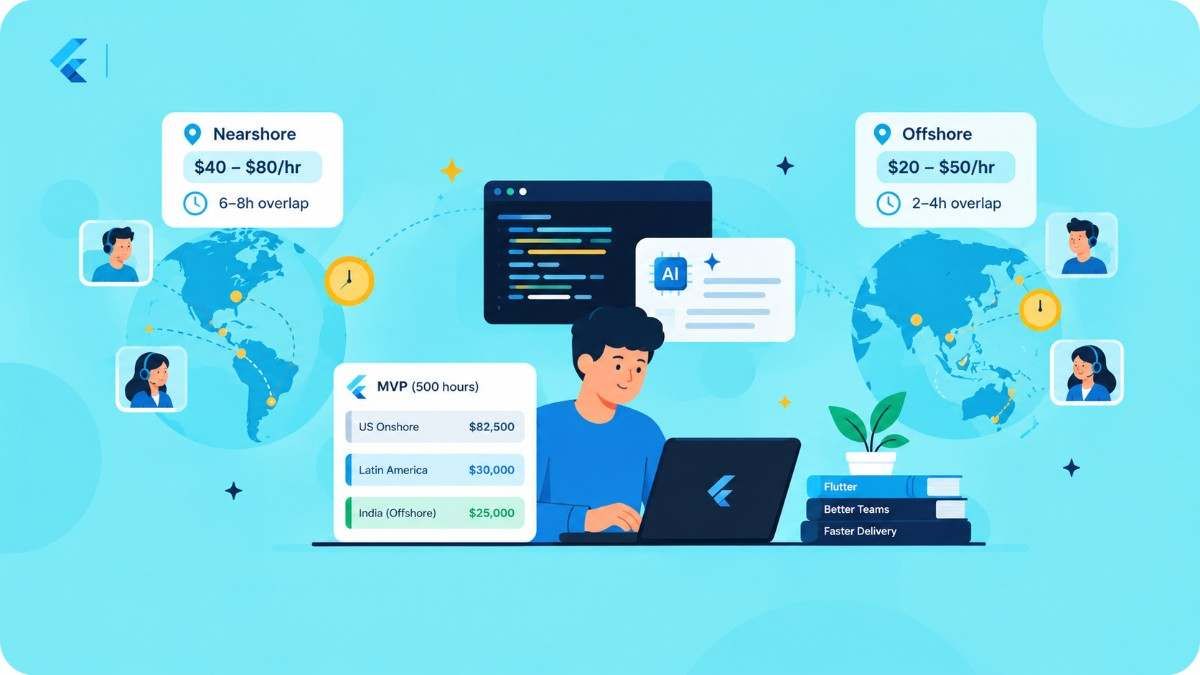
| Latin America (nearshore) | $40 - $80 | US time zone overlap is the premium |
| Eastern Europe | $30 - $45 | Comparable senior output at a wide discount |
| South and Southeast Asia | $18 - $40 | Widest quality variance; vetting matters most here |
The single most useful thing to understand about these numbers: the biggest rate driver is not years of experience. It's whether a developer can own the Dart-to-native bridge rather than only writing widgets. Platform channels, release engineering, and native integration are where builds stall, and they're what separates a $45 engineer from a $90 one far more reliably than a résumé does.
We break the full picture down in our guide on the cost to hire a Flutter developer, including monthly retainer math and what changes at each seniority tier.
One warning on nearshore and offshore. The savings are real, and they evaporate the moment you have to rewrite. Founders who report offshore going badly almost always skipped the vetting step, not the geography.
Directory rankings sort by review count and office locations. Neither predicts whether a team will ship your product. Here's what we'd tell a founder to actually ask, including when they're evaluating us:
We wrote a longer piece on red flags when hiring dedicated Flutter developers that covers the warning signs on the other side of this list. If you want the vendor-landscape view instead, our roundups of startup app development companies and mobile app development companies for startups cover who's operating in this space.
Sixteen weeks, assuming standard MVP scope and a decision-maker who's available. Fewer weeks is possible. Fewer weeks with the same scope usually isn't.
| Phase | Weeks | What happens | Where founders lose time |
| Scoping and architecture | 1 - 2 | Requirements, feature cut, technical approach, estimate | Refusing to cut features |
| UX and UI design | 2 - 3 | User flows, wireframes, screens, design system | Design-by-committee reviews |
| Core development | 4 - 9 | Sprint-by-sprint build with demos every two weeks | Silence between demos |
| Integration and QA | 3 - 4 | Third-party services, device testing, edge cases, performance | Treating QA as optional |
| Store submission | 1 - 2 | App Store and Play Store review, metadata, screenshots | Starting compliance prep too late |
Two notes from experience. Cut features at scoping, not mid-build. A feature removed in week one costs nothing, and the same feature removed in week seven costs everything already spent on it. And show up to your demos. The founders whose builds go smoothly are the ones in the room every two weeks. It's the cheapest project insurance available.
Our Flutter for MVP development guide covers the scoping discipline that makes this timeline hold.
A fixed-price agency contract makes sense when your scope genuinely won't move. For a first product, it almost always will.
Choose a dedicated team when:
Choose a project agency when:
If the dedicated model fits, our hire dedicated Flutter app developers page covers engagement structures, vetting process, and how quickly we can put senior Flutter engineers into your sprints. Founders who want the nearshore-versus-offshore comparison specifically will find our piece on nearshore Flutter app development useful.

Most startup app builds cost $15,000 to $120,000. Lean single-feature apps start near $15,000; standard MVPs run $40,000 to $80,000. Budget another 20 to 40 percent on top for hosting, maintenance, and post-launch iteration.
Nine to twenty weeks for most first builds. A lean MVP takes 6 to 10 weeks. Standard scope runs 10 to 16 weeks including QA and app store submission. Complex or regulated products take longer.
Cross-platform for most consumer products. It costs 30 to 40 percent less than separate native codebases, with 70 to 90 percent code reuse. Choose native only if hardware access like Bluetooth or biometrics is core to your product.
Freelancers have lower hourly rates but often higher total cost, because you supply the project management and coordination. A senior dedicated team frequently ships in fewer hours, which lowers the total.
Two to four for most MVPs: one or two Flutter engineers, a designer, and QA. Adding people shortens the calendar but raises total cost. Team size should follow scope, not ambition.
In theory yes, in practice partly. One Flutter engineer covers both platforms, but native integration work still requires platform-specific knowledge. Budget for a developer who can own the Dart-to-native bridge, not just UI.
Timelines quoted before any scoping conversation, estimates with no stated assumptions, unclear code ownership, and salespeople who disappear after signing. Insist on meeting the engineer who will write your code.
Let’s begin a collaborative journey together where we craft Flutter applications that set benchmarks for you.