Paresh Mayani
18 August 2026
share article


Short answer: Cross-platform app development means building one codebase that runs on iOS, Android, web, and desktop, instead of writing separate apps for each. For most US products, it ships faster, costs 30 to 40 percent less than two native builds, and now performs within about 90 to 95 percent of native. The real decision is not "cross-platform or not." It is which framework fits your product, and who you hire to build it.
This guide covers what the technology is and what it costs to build in the US. It also covers current developer rates and how to hire a team without paying for a rewrite later.
Cross-platform app development is the practice of building an app from one shared codebase. That codebase runs on multiple operating systems, mainly iOS and Android, and often web and desktop too. You write the code once. It deploys everywhere.
Compare that to native development. There, you build two separate apps: one in Swift for iOS, one in Kotlin for Android. Two codebases. Two teams, usually. Two sets of bugs to fix.
With cross-platform, one team writes the app in one language, using a framework such as Flutter, React Native, or .NET MAUI. The framework handles most of the platform differences for you. When you do need something platform-specific, like a camera feature or a payment SDK, you can still drop into native code for that one piece.
Overall, the mechanics are simpler than most vendor pages make them sound.
A cross-platform framework gives you a unified set of building blocks: UI components, navigation, state handling, and access to device features. You build your app with those blocks. Then the framework compiles or renders your code so it works on each target platform.
Frameworks take two main approaches here. Flutter draws its own UI with a built-in rendering engine, so the app looks identical on every device. React Native maps your components onto the platform's own native UI elements. Both give you a single codebase. They just get to the finish line differently.
Because roughly 70-90% of the code is shared across platforms, your team spends far less time duplicating work. The remaining slice handles the platform-specific extras: push notifications, biometric login, deep hardware access.
For most business apps in 2026, cross-platform is the sensible default. Still, native wins in a few specific cases. Here is the honest breakdown.
| Factor | Cross-Platform | Native |
| Codebases | One | Two (iOS + Android) |
| Time to market | Faster | Slower |
| Cost | 30 to 40% lower for iOS + Android | Higher |
| Performance | ~90 to 95% of native for most apps | Maximum |
| Best for | MVPs, business apps, e-commerce, social, content | Graphics-heavy games, AR, real-time hardware work |
| Talent pool | Large (JavaScript, Dart) | Smaller per platform |
The performance gap used to be the deal-breaker. It is not anymore. Modern frameworks reach about 90 to 95 percent of native performance for most apps. That is plenty for e-commerce, on-demand, fintech dashboards, and social products. You would only feel the difference in graphics-intensive games or apps doing heavy real-time processing.
So the choice is rarely technical now. It comes down to budget, timeline, and how many platforms you need on day one. If you need iOS and Android at launch, cross-platform almost always wins. If you are building a single-platform app with deep OS integration, native may still be worth it.
The upside is easy to list, but the trade-offs matter too. A good partner will tell you both.
Benefits:
Trade-offs:
That last point is the one founders underestimate. Which brings us to frameworks and hiring.
There is no single "best." The right pick depends on your product and your team. That said, the field has narrowed, and Flutter has pulled ahead for most new consumer and business apps.
Flutter leads cross-platform adoption at roughly 46 percent of mobile developers heading into 2026. Built by Google, it uses the Dart language and renders its own UI, so your app looks pixel-identical on every screen. It covers iOS, Android, web, and desktop from one codebase. It is the strongest fit for UI-heavy consumer apps, MVPs that need to look polished fast, and products where a consistent look matters. This is why so many teams hiring for new builds start their search with Flutter developers.
React Native sits second at about 35 percent adoption. Built by Meta, it uses JavaScript and React, so any experienced web developer can move into it quickly. That makes hiring easier if your team already lives in the JavaScript world. It is a strong pick for content apps, marketplaces, and products with frequent UI changes.
.NET MAUI is Microsoft's option, best for enterprises already standardized on the Microsoft stack and C#.
Kotlin Multiplatform takes a different route. It shares your business logic across platforms while keeping native UI on each. It appeals to teams that want native UI control but hate duplicating core logic.
Ionic is web-first. It suits teams with strong web skills who want to reach mobile through web technologies and Progressive Web Apps.
For a US startup or scale-up building a new mobile product this year, Flutter is the safest default. React Native is the better call when you have a JavaScript-heavy team you want to keep. Everything else is situational.
Cross-platform app development in the US typically costs between $25,000 and $200,000, depending on complexity. That range is wide because "an app" can mean a simple MVP or a regulated enterprise platform.
Here is a practical breakdown, drawn from 2026 US pricing guides such as Netguru and other agency reports. Treat these as planning ranges, not quotes.
| Project type | Typical US cost | Rough timeline |
| MVP (core features, one flow) | $25,000 to $60,000 | 3 to 4 months |
| Mid-level (APIs, integrations) | $60,000 to $150,000 | 6 to 9 months |
| Enterprise (compliance, scale, AI) | $150,000 to $300,000+ | 12+ months |
In practice, two things drive the number more than anything else: feature complexity and team rate. Framework choice barely moves the total. A Flutter build and a React Native build of the same scope land close to each other. What moves the budget is who builds it and how much you ask the app to do.
Cross-platform saves you money because you run one team instead of two. That saving is largest on simpler apps, where the two-codebase overhead is a bigger share of the work. It shrinks on enterprise builds with heavy native modules. Remember to budget ongoing maintenance too. It usually adds 15 to 20 percent of the build cost per year.
This is where most guides go quiet, so here is the part you actually came for.
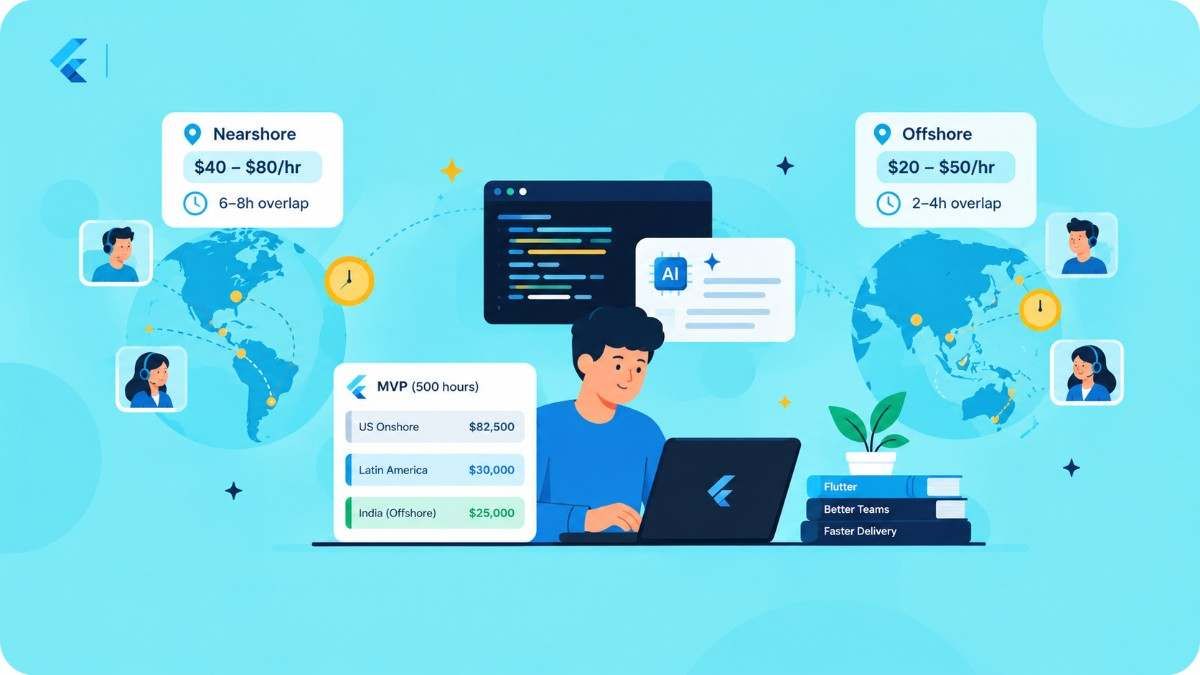
For context, US developer rates are among the highest in the world, generally $80 to $150+ per hour. Cross-platform developers tend to sit a little below native specialists for the same scope, because a single codebase covers both platforms. Here are 2026 benchmark ranges for Flutter and React Native talent
| Model | US rate | Offshore rate |
| Freelance (senior Flutter / RN) | $80 to $150/hr | $25 to $65/hr |
| Fully loaded senior hire (annual) | $175,000 to $265,000/yr | $40,000 to $85,000/yr |
| Dedicated / agency team | Mid to high | Lower, with overlap hours |
The offshore gap is real, and it is large. A US company can save 55 to 70 percent versus a fully loaded US hire by going offshore, according to 2026 rate reports. The catch is quality. Cheap hourly rates that lead to a rebuild cost you more in the end. The goal is not the lowest rate. It is the best value: a strong developer whose code you will not have to throw away.
That is the model many US founders land on. They keep product and strategy close to home, then hire vetted senior cross-platform developers who overlap with US hours. You get US-quality output at a rate that leaves budget for marketing and growth. If that is the route you want, our team can match you with vetted senior Flutter developers.
In our experience, a weak hire is the single most expensive mistake in an app build. The rewrite costs more than the rate premium a strong developer would have charged. Screen for these before you sign anything.
Then pick the engagement model that fits your stage:
One more filter: a partner who says "yes" to every request in the sales call is a warning sign, not a green light. Strong teams push back and scope honestly.
So match the choice to where your business actually is. Here is a simple way to decide.
For the large majority of US products, cross-platform will do the job well. In fact, the framework and the team you hire matter far more than the "cross-platform vs native" debate itself.
If you are planning a cross-platform app and want senior developers who ship production-quality Flutter without the rewrites that sink weaker builds, talk to our team. We match US companies with vetted cross-platform engineers who overlap with your working hours.
For most apps, yes. Modern frameworks reach about 90 to 95 percent of native performance, which covers e-commerce, social, fintech, and business apps. Native keeps an edge only for graphics-heavy games, AR, and hardware-level real-time work.
There is no single winner, but Flutter leads adoption and is the safest default for new consumer and business apps. React Native is the better pick when your team already knows JavaScript. .NET MAUI suits Microsoft-stack enterprises.
Building for both iOS and Android with one codebase typically costs 30 to 40 percent less than two separate native builds. The saving comes from running one team in one language instead of two.
Senior US freelancers generally run $100 to $180 per hour. A fully loaded senior in-house hire is roughly $170,000 to $210,000 per year. Offshore senior talent runs far lower, often $25 to $65 per hour, though quality varies and matters more than rate.
An MVP usually takes 3 to 4 months. A mid-level app with integrations runs 6 to 9 months. Enterprise builds take 12 months or more.
Use a freelancer for a small, clearly scoped MVP. Choose a dedicated developer or agency for apps with real users, ongoing maintenance, or timelines you cannot afford to miss.
Let’s begin a collaborative journey together where we craft Flutter applications that set benchmarks for you.