Paresh Mayani
22 September 2026
share article


Ask three Flutter shops what your app will cost and you will get three numbers that do not agree, plus the word nearshore, which by now means almost nothing. I want to give you the actual figures and let you do your own arithmetic.
We build Flutter apps for US companies out of India. That makes us offshore. I am going to tell you where that costs you something, because you will find out anyway and it is better coming from us.
The short version
|
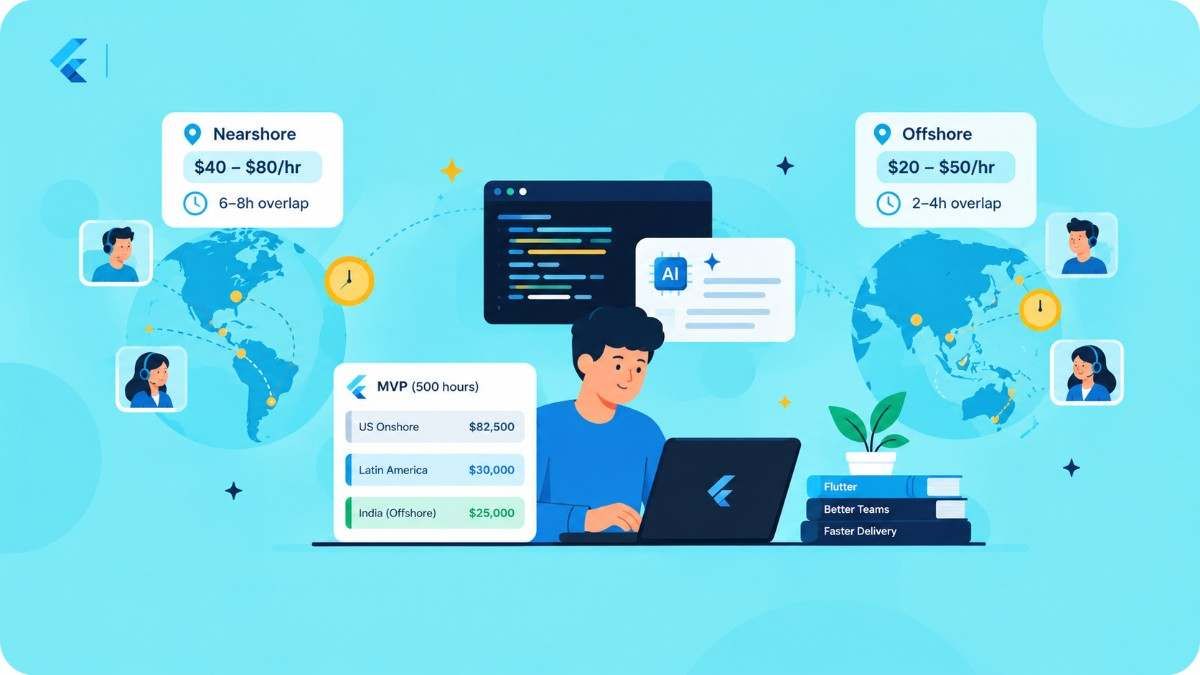
Nearshore means a team within about three hours of your time zone. If you are in the US, that is Latin America. Colombia, Mexico, Argentina, Brazil.
It does not mean Eastern Europe and it does not mean Asia. Plenty of vendors on both continents call themselves nearshore anyway, which is how the word stopped being useful.
Offshore means eight hours or more. India, Pakistan, the Philippines, and most of Eastern Europe if you are on the West Coast.
None of this is about skill. Flutter is the same framework everywhere and Dart is the same language. It is about how many hours a day both sides are awake, and what that does to how fast you can decide things.
These are blended senior rates for agency and staff augmentation work. I have listed direct hire separately because comparing a salary to an hourly rate is misleading. A salary leaves out benefits, equity, recruiting cost, and the two to four months you spend hiring.
| Model | Senior Flutter rate | Overlap with US hours | Ramp time |
| US onshore agency | $150 to $185/hr | Full | 2 to 6 weeks |
| US direct hire | $120,000 to $160,000+/yr | Full | 2 to 4 months |
| Latin America (nearshore) | $40 to $80/hr | 6 to 8 hours | 2 to 4 weeks |
| Eastern Europe | $40 to $80/hr | 2 to 4 hours | 2 to 4 weeks |
| India and South Asia (offshore) | $20 to $50/hr | 2 to 4 hours with shift overlap | 1 to 2 weeks |
Hourly rates on their own are close to useless. Here is a standard Flutter MVP instead. Call it 500 hours of senior time covering architecture, UI, one backend integration, QA, and getting it into the stores.
| Model | 500-hour MVP | Against US onshore |
| US onshore at $165/hr | $82,500 | - |
| Latin America at $60/hr | $30,000 | 64% less |
| India at $50/hr (senior) | $25,000 | 70% less |
Two costs that table hides.
A cheap hour multiplies. If your 500-hour estimate turns into 800 hours, most of a 40% rate advantage is gone. Being strict about scope is worth more than picking the right continent.
And rework bills at the same rate as work. A decision waits a day because nobody was awake, the team builds the wrong thing in the meantime, and you pay for both versions.
We are offshore and I will still tell you to go nearshore in these cases.
Every rate above is lower in real terms than it was two years ago, and nobody cut their prices. AI assistants absorbed work that used to get billed by the hour. If you are pricing a build in 2026 using 2023 assumptions about how many people you need, you are budgeting for headcount that no longer exists.
What the tools handle well in Flutter is what juniors used to do. Scaffolding widget trees. Boilerplate state classes. Model classes from JSON. First pass unit tests. Turning a design file into a layout.
What they do not handle is the work that decides whether your app survives real users. Picking state management that still makes sense at fifty screens. Chasing jank that only shows up on a mid range Android phone. Writing a platform channel when no plugin exists. Knowing what not to build.
For your budget that means smaller teams, more seniority per head, roughly the same total, delivered sooner. If a vendor quotes you five people for an MVP and three of them are juniors, they are either not using the tooling or they are selling you headcount. Ask which.
Maintenance is where the money actually moved, and it is the part nobody prices properly at the start. Most of what an app costs you happens after launch.
Commercially that means a retainer quoted in 2026 should cost less per feature than one quoted in 2024. A vendor who has not repriced maintenance has not changed how they work. Ask what their crash to fix time is now against two years ago. A team that really adopted this stuff answers with a number.
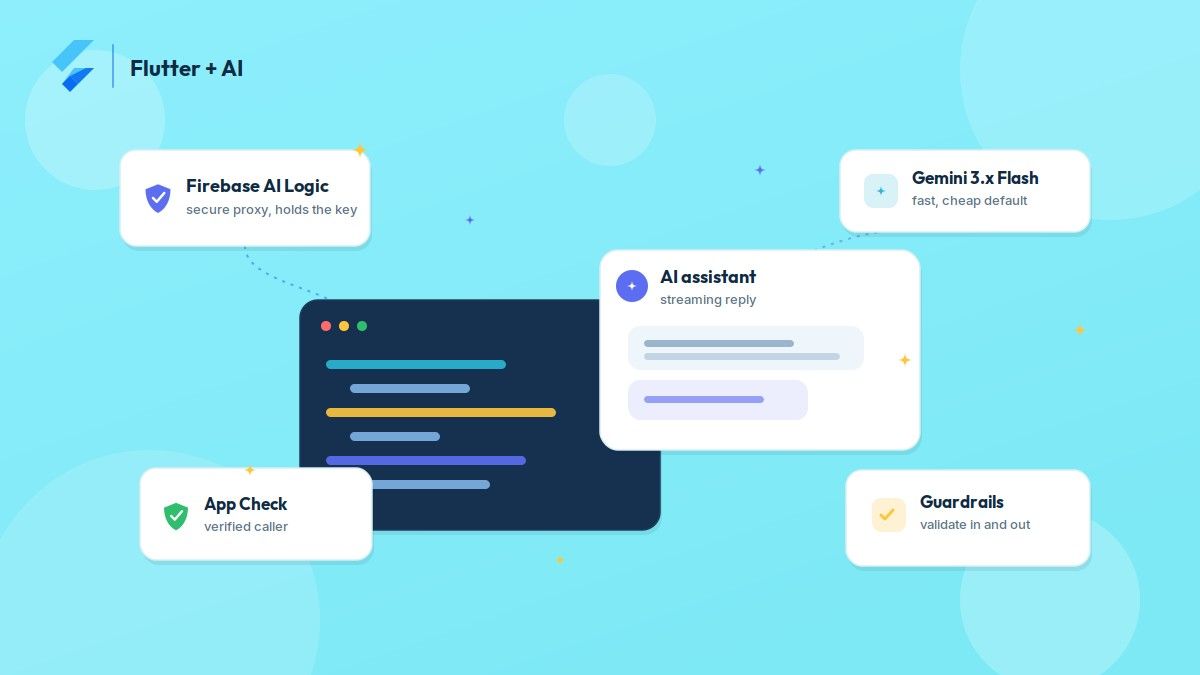
Separate question from AI helping build the thing. Shipping AI inside the app is a normal line item now.
There is a specific trap here. On device inference is a one off build cost. Hosted model features carry a monthly bill per user that grows as you succeed. A chat feature that is fine at a thousand users can become your biggest infrastructure line at a hundred thousand. Model that before the feature gets built. If a vendor quotes you an AI feature without asking how many calls you expect, they have not thought about it.
This changes how you hire and most processes have not caught up.
Banning the tools during a technical test tells you how somebody works in conditions they will never see again. Hand them a real bug in a messy codebase instead, let them use whatever they want, and watch. You are checking whether they notice when the assistant is confidently wrong. In Flutter that usually looks like a deprecated widget, an old null safety pattern, or a package that got abandoned two years ago.
The question I would ask outright: tell me about a time an AI suggestion looked right and was not. Anyone paying attention has three stories ready. Anyone who does not has been shipping the output unread, and you will discover that later at a worse moment.
Question three is the one that sorts the grown ups from everybody else. If nobody at the company can answer it, that is your answer.
Geography predicts very little. These checks do more work.
Nearshore buys overlapping hours. Offshore buys rate and depth. AI shrank both teams and should have shrunk your maintenance bill along with them.
If your product is still being figured out, pay for the overlap. If your spec is solid, keep the money.
We are an offshore Flutter team working with US companies, and we will tell you when we are not the right fit.
No. Nearshore beats US onshore on price but usually costs more than offshore. Senior Flutter rates in Latin America run $40 to $80 an hour and our own senior rate tops out at $50. The nearshore premium buys overlapping hours, not a lower invoice.
For a 500-hour build, roughly $82,500 with a US onshore agency at $165 an hour, or about $30,000 with a Latin American team at $60. Offshore comes in under both. Scope moves the final number far more than geography does.
No. India is offshore for a US client. The gap is nine to twelve hours. Some vendors use the word loosely, so ask for committed overlap hours instead of trusting the label.
Crash triage, which clusters stack traces and points at the likely commit. Dependency and SDK migration during version bumps. Regression tests written automatically when a bug gets fixed. First pass code review. Documentation upkeep. The result is a shorter crash to fix cycle, which is why a 2026 retainer should cost less per feature than a 2024 one.
Not in 2026. The tools handle boilerplate widgets, test scaffolding, and routine refactors, which squeezes the junior end of the work. Architecture, state management design, platform channels, and debugging production problems still need someone experienced. You get smaller teams shipping the same scope, not no teams.
Usually yes, but settle the data policy first and get it in writing. Some assistants send code to third party providers, which is a compliance problem under GDPR and HIPAA and may break promises you made to your own customers. Ask which tools, whether there is a zero retention enterprise agreement, and who reviews the output before merge.
Yes. Most vendors do fixed scope pricing, hourly, or a dedicated team on monthly retainer. Fixed scope suits a defined MVP. A dedicated team suits a roadmap that keeps changing.
Let’s begin a collaborative journey together where we craft Flutter applications that set benchmarks for you.