Most bad Flutter hires don't fail loudly. They fail quietly, four months in, when a feature that should take two days takes two weeks, and nobody can explain why.
If you're about to hire dedicated Flutter developers, the nine warning signs below predict that outcome. They show up in the first conversation, in the portfolio, and in how a candidate answers one specific question about state management. None of them requires you to be technical. They just require you to know what to listen for.
We've staffed Flutter teams for US startups and product companies for years, and the pattern is consistent: the expensive mistakes are rarely about hourly rate. They're about a developer who can assemble widgets but can't ship, debug, or hand off. This guide covers what to check before you sign anything.
Because you pay for the mistake twice: once to build it, once to rebuild it.
Flutter's popularity is exactly what creates the risk. Statista's global developer survey found that <cite index="16-1">46 per cent of software developers reported using Flutter, making it the most popular cross-platform mobile framework</cite>. A talent pool that large means plenty of people list "Flutter" on a profile after six months of tutorials. The framework is genuinely approachable, which is its strength as a technology and its weakness as a hiring signal.
Here's the math that matters. <cite index="6-1">Glassdoor puts the average US Flutter developer salary at $120,116 per year, or roughly $58 per hour, with the 75th percentile reaching $154,523</cite>. When you find Flutter developers for hire at a fraction of that, the gap isn't automatically a scam; offshore and nearshore markets are legitimately cheaper. But if a weak developer takes three times the hours and leaves behind code your next team has to rewrite, the cheaper rate produced the more expensive project.
That's the actual risk. Not the rate. The rework.
This is the single highest-signal question you can ask, and you don't need to understand the answer to judge it.
Ask: "What state management do you use, and why did you pick it for your last project?"
A strong Flutter programmer will name something specific Riverpod, BLoC, Provider, signals and then tell you what the tradeoff was. Something like "we used BLoC because the client had a large team and needed enforced structure, though it added boilerplate." That's a real answer. It contains a cost.
A weak one says "whatever the project needs" or names a package with no reasoning attached. State management is where Flutter apps go wrong at scale. If they haven't thought about it, they haven't built anything big enough to hurt yet. Our guide to state management in Flutter covers the tradeoffs if you want to follow the conversation more closely.
Flutter is not a way to avoid iOS and Android. It's a way to write most of your app once and still touch both platforms when you need to.
Push notifications, in-app purchases, deep links, background location, HealthKit, Bluetooth every one of these eventually needs a platform channel and some Swift or Kotlin. A developer who has never written a line of native code will hit a wall on your third integration and stay there.
Ask what native code they've written and what they used it for. "None, we use packages for everything" is a real limitation, not a strength.
Anyone can produce screenshots. Very few people can produce a live App Store or Play Store listing with their work in it.
When you hire Flutter app developers, ask for links to shipped apps, then actually open two of them. Check the reviews for crash complaints. Check the update history; an app last updated 18 months ago says something about who maintained it.
If everything is under NDA, that's plausible for one or two projects. It's not plausible for an entire portfolio.
A two-to-three day paid task is the most reliable signal in the entire process, and it's the one most people skip.
Give a scoped piece of real work: build a screen that pulls from an API, handles the loading and error states, and includes a test. Pay market rate for it. You'll learn more from that than from four interviews.
Serious candidates say yes. They know they'll do well. The ones who refuse usually have a reason, and it's rarely the one they give you. Any dedicated Flutter development team that won't put a trial on the table is asking you to take on all the risk.
This one costs US companies more than any other, and it's specific to agency engagements.
You interview a strong senior. You sign. A junior does the work, and the senior appears on standup twice a month. Nobody lied to you exactly, but the person you evaluated isn't the person shipping.
Ask directly, before contracts: Who is on my team, by name? Can I interview each of them? Are they allocated to other clients? What's the notice period if you replace someone? A Flutter app development company that answers those four questions clearly is telling you something real about how they operate.
Ask who submits to the App Store. It's a boring question that separates people fast.
Developers who have owned a release know the whole unglamorous chain: code signing, provisioning profiles, TestFlight, review rejections, staged rollouts, crash monitoring. Developers who have only written features will hand you a branch and expect someone else to figure it out.
Same with tests. You don't need 90% coverage. You need a candidate who can tell you what they test and what they deliberately don't. "We don't write tests, we test manually" on a product you plan to maintain for years is a red flag about how they think, not just about tooling.
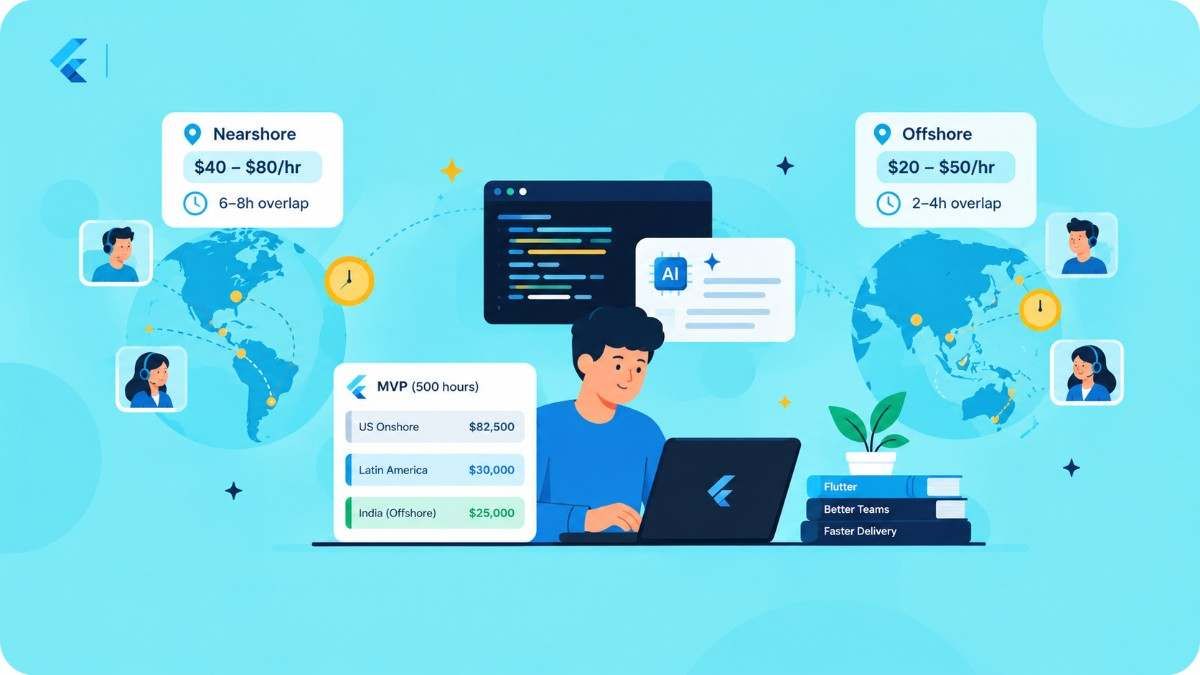
Cheap has a reason. Sometimes it's a good one: cost of living in a strong engineering market, a newer agency building a portfolio, a nearshore model with genuine efficiency behind it. Those are fine, and we've written about why nearshore Flutter development works for exactly this reason.
Sometimes the reason is that you're getting a junior with a senior's title, or a developer juggling four clients, or a team that will pad hours later.
Just ask. "Your rate is well below what we've seen; help me understand the model." Confident teams explain it in one paragraph. If the answer is defensive or vague, that tells you enough. For current benchmarks, our breakdown of the cost to hire a dedicated Flutter developer has the ranges by region and seniority.
Remote engineering runs on writing. If a candidate's messages are hard to follow, that friction compounds daily for the length of your project.
The other half is overlap. Two to four hours of genuine working overlap with your team is the practical minimum for anything with unclear requirements. "We'll be available whenever you need" usually means asynchronous-only in practice, which is workable for maintenance and painful for early-stage product work where scope shifts weekly.
Watch how they respond during the hiring process itself. Response speed and clarity before you're a client is the best version of that behaviour you'll ever see.
Get this in writing before work starts, not after.
You want explicit answers on four things: you own the source code and design files outright, the repository lives in your organisation from day one, an NDA is signed before any discussion of your product, and there's a documented handover if the engagement ends.
Any hesitation here is disqualifying. This isn't a negotiation point; it's a baseline. We hand over repository access from the first commit because the alternative creates a dependency neither side should want.
Use this on your next call.
| Area | Red flag | Green flag |
| State management | "Whatever fits the project" | Names a choice and its tradeoff |
| Native code | Never written Swift or Kotlin | Has shipped platform channels |
| Portfolio | Screenshots only | Live store links you can open |
| Trial task | Declines a paid trial | Welcomes it, scopes it themselves |
| Team clarity | Won't name the actual developers | Named team, interviewable, allocation stated |
| Release process | "Someone else handles deployment" | Has owned App Store submissions |
| Pricing | Far below market, no explanation | Clear rationale for the rate |
| Communication | Slow, unclear writing | Sharp async writing, real overlap hours |
| Ownership | Vague on IP and handover | Repo access day one, NDA upfront |
Need a Flutter team that clears all nine? See how we work →
Run the trial task. If you take one thing from this article, take that.
Interviews reward people who interview well. A paid two-day task rewards people who build well, and those are different populations. Combine it with two questions, the state management question and the "who writes the code" question, and you'll filter out most of the risk before you've spent real money.
For anything past an MVP, we'd also push you to think in terms of a team rather than an individual. A single developer, however strong, is a single point of failure on vacations, illness, and the day they take another offer. When companies hire dedicated Flutter app developers as a small pod with a lead, the bus factor problem mostly goes away.
Two to four weeks for a solo hire including a trial task. Through an agency with a bench, one to two weeks. If someone promises a start date tomorrow, ask who they're pulling off another project.
No. Rate reflects geography as much as skill. The problem isn't a low rate it's a low rate nobody can explain. Ask for the reasoning and judge the answer.
Freelancers suit short, well-defined scopes. A dedicated Flutter development team suits products that will keep evolving, because continuity, code review, and coverage during absences all matter more over time.
Yes. Pay for a small trial and have any senior engineer review the output, even a contract, or for two hours. That review costs a few hundred dollars and can save months.
FlutterFlow is a genuine fit for internal tools and fast validation. It gets constraining once you need custom native integrations. Our overview of FlutterFlow development companies covers where the line sits.
Not usually. Timezone overlap and communication quality predict outcomes far better than location. Distributed teams work well when overlap hours are real and set in advance.
The nine flags above come down to one question: can this person ship, or can they only build?
Shipping means state management decisions that survive scale, native code when packages run out, releases that reach the store, tests that catch regressions, and code you own outright. Building means widgets on a screen.
Both look identical in a portfolio. They diverge sharply around month four.
Ask the hard questions early. Pay for a trial. Confirm ownership in writing. If you'd like a shortlist of vetted Flutter developers who've already cleared this bar, our team can put one in front of you this week.

Paresh Mayani
20 August 2026

Paresh Mayani
18 August 2026

Paresh Mayani
13 January 2026
Let’s begin a collaborative journey together where we craft Flutter applications that set benchmarks for you.