08 September 2026
share article


You have budget approved and a launch date on the roadmap. Now you have to decide whether to hire Flutter developers who plug into your existing team, or buy Flutter mobile app development services where an outside team owns delivery end to end. Most guides treat these as the same purchase. They are not.
The short answer: hire developers when you already have a product manager, a designer, and someone technical who can review code. Buy services when you need the whole function, including scoping, design, QA, and release management. Pick the wrong one and you either pay for capability you already have, or you hand a developer a job that needed a team.
We staff Flutter teams for US startups and product companies under both models, so we see the same mistake from both directions. Founders buy a solo developer and then discover nobody owns the App Store submission. Enterprises buy a full delivery pod for work their internal team could have absorbed with two extra engineers. This guide covers how to tell the difference before you sign.
Key takeaways
|
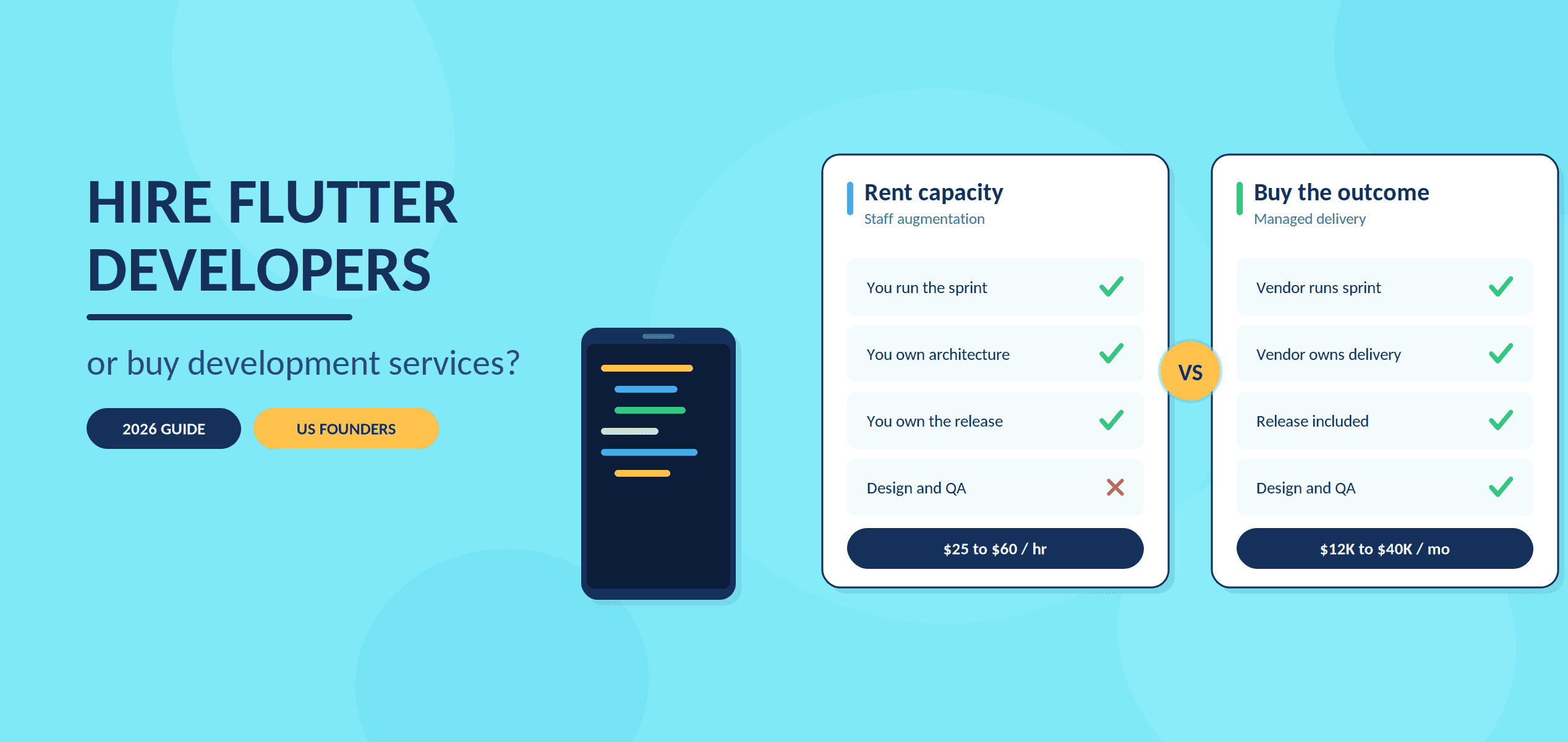
The difference is who owns the outcome. Under staff augmentation you rent capacity and keep accountability. Under a services engagement you buy an outcome and transfer part of that accountability to the vendor.
That single distinction cascades into everything else: how you price the work, who runs standups, who decides the architecture, and who gets called at 11pm when the release build fails code signing.
| Dimension | Hire Flutter developers (staff augmentation) | Buy Flutter development services (managed delivery) |
| What you buy | Engineering hours inside your process | A shipped product against a scope |
| Who runs the sprint | Your PM or engineering lead | The vendor’s delivery manager |
| Who owns architecture | You, with developer input | The vendor, subject to your sign-off |
| Design and QA included | No, unless you buy those roles separately | Usually yes, as part of the pod |
| Release ownership | Yours | The vendor’s, through to store approval |
| Typical commitment | Monthly, rolling | Project or quarterly milestones |
| Fails when | You have no internal technical owner | Your scope changes weekly |
Notice the last row. Staff augmentation absorbs changing requirements well because you are directing the work in real time. Fixed-scope delivery does not, because every change becomes a change order. Teams that are still discovering their product usually do better renting engineers than buying a defined deliverable.
Stage predicts the right model better than company size or budget does. Here is how the three common situations break down.
At this stage you usually do not have a designer, a QA engineer, or a technical reviewer. Hiring one developer means that person also becomes your product manager, your tester, and your release engineer. Very few people are good at all four, and the ones who are cost more than a small pod.
Managed delivery works better here because the vendor supplies the missing roles. Our guide to Flutter for MVP development covers how to scope a first version tightly enough that fixed delivery stays honest.
Once you have a product manager and at least one senior engineer, staff augmentation becomes the efficient choice. You already own the decisions. What you lack is throughput, and throughput is the cheapest thing to buy.
This is where most companies hire Flutter developers on a dedicated basis: full-time on your project, in your standups, but off your payroll. Our breakdown of the cost to hire a dedicated Flutter developer has current ranges by region and seniority.
Larger teams tend to run a hybrid. Core platform work stays in-house or with embedded augmented developers. Discrete projects, such as a native to Flutter migration or a new consumer app, go to a delivery pod with its own milestones.
The split works because it protects your core codebase from vendor churn while still letting you parallelise. It fails when nobody defines the interface between the two teams, which is why we insist on a written integration contract before a pod touches shared code.
Compare total cost of ownership, not hourly rate. The hourly rate is the smallest part of the difference between these models.
| Model | Typical US-facing rate | What is included | Time to start |
| US full-time employee | $90K to $160K salary | One engineer, nothing else | 4 to 8 weeks |
| US freelancer | $80 to $150 per hour | One engineer, part-time attention | 1 to 2 weeks |
| Dedicated offshore developer | $25 to $60 per hour | One engineer, full-time, managed by you | 1 to 2 weeks |
| Managed delivery pod | $12K to $40K per month | Developers, QA, design, delivery lead | 2 to 4 weeks |
Rate ranges in the cost table are market planning envelopes aggregated from live 2026 vendor and marketplace pricing. They are presented as ranges rather than as a sourced statistic. Refresh them each cycle.
Ranges reflect what US buyers were quoted across the market through 2026. Treat them as a planning envelope, not a quote.
A US salary is roughly two thirds of what that hire actually costs you. According to the Bureau of Labor Statistics, wages and salaries accounted for 69.9 percent of employer compensation costs in private industry in March 2026, with benefits making up the remaining 30.1 percent.
So a $120,000 Flutter engineer costs closer to $170,000 once benefits land, and that is before a recruiter fee of 15 to 20 percent of first-year salary and six to eight weeks of ramp during which output is low. Model the loaded number or your first quarter will look like a budget failure when it is really a forecasting failure.
Delivery pods look expensive per month and are often cheaper per shipped feature, because the roles you would otherwise hire separately are already inside the price. If a project needs 0.4 of a designer and 0.5 of a QA engineer, you cannot hire those fractions. A pod gives you them by default.
This is the section most hiring guides skip, and it is where the expensive surprises live. Two issues change materially depending on which model you pick.
If you engage an individual contractor directly, classification risk is yours. The IRS looks at behavioural control, financial control, and the nature of the relationship to decide whether someone is genuinely a contractor or an employee in practice. A contractor who sits in your Slack daily, attends your standups, and takes direction from your engineering manager looks a lot like an employee to an auditor.
California applies a stricter standard through its ABC test, which presumes employment unless the hiring business can satisfy all three prongs. If you have California operations, assume it applies even to remote contractors elsewhere and take advice before you sign.
When you engage through an agency or a services vendor, the developer is on the vendor’s payroll and classification is the vendor’s obligation. That transfer of risk is a real part of what you are paying for, and it is worth asking the vendor to confirm it in writing.
No engagement structure automatically gives you the code. You need explicit work-for-hire language assigning all source code, designs, and documentation to your company from the moment of creation. We hand over repository access from the first commit for exactly this reason, because anything else creates a dependency neither side benefits from.
Three clauses belong in every Flutter contract, regardless of model:
Ambiguous IP language tends to surface at the worst possible moment, which is diligence. Fixing it then costs far more than getting it right on day one.
The evaluation criteria overlap more than people expect. Whether you are assessing one developer or a whole vendor, you are testing the same four things: technical depth, shipping history, communication, and ownership terms.
Flutter’s accessibility is what makes this hard. Statista’s global developer survey found that 46 percent of software developers reported using Flutter, making it the most-used cross-platform framework. A talent pool that large contains plenty of people who added Flutter to a profile after a few tutorials.
Three questions separate the two groups quickly:
For the full checklist, our post on the nine red flags to watch when hiring dedicated Flutter developers covers what to listen for on the first call.
Define what “working” looks like before the engagement starts, because month one is when problems are still cheap to fix. We use a simple three-gate structure with clients under either model.
| Gate | By when | What good looks like |
| Environment and first commit | Day 3 | Local build running, first pull request opened, CI green |
| First shippable slice | Day 14 | One real feature merged with tests, reviewed by your side |
| Release rehearsal | Day 30 | A build on TestFlight and internal Play track, signed and installable |
The third gate matters most, and almost nobody sets it. A team that has not produced an installable build by day 30 has usually hit something structural, and finding that in month one rather than month four is worth a great deal.
AI coding assistants have compressed the gap between a competent developer and a fast one, which changes what you should screen for. Boilerplate, widget scaffolding, and test stubs are no longer where senior engineers earn their rate.
What has not changed is judgement: architecture decisions, knowing which generated code to reject, and debugging behaviour that only shows up on a real device on a slow network. Screen for review discipline rather than typing speed. Ask a candidate to describe something an AI assistant suggested that they overruled, and why.
Practically, this shifts the value of managed delivery upward. A pod with established review standards gets more out of these tools than an unsupervised solo contractor does. Our roundup of the best AI tools for Flutter covers what our teams actually run day to day.
Answer these honestly and the model usually picks itself. Count your yes answers.
Four or more yes answers: hire developers into your team. You have the surrounding function already, and augmentation is the cheaper way to add throughput.
Three or fewer: buy Flutter app development as a managed service until you have built the missing roles internally. Paying a vendor to cover a gap is cheaper than discovering the gap in month four.
Two related reads if you are still weighing options: our budget and hiring playbook for startups works through the same decision from a runway perspective, and our cross-platform app development guide covers the framework choice that sits underneath it. If timezone overlap is your main constraint, nearshore Flutter development is worth a look.
The choice between hiring Flutter developers and buying development services is really a question about what your team already covers. Rent capacity when you own the decisions. Buy the outcome when you do not.
Whichever way you go, three things stay constant: get IP assignment in writing before the first commit, insist on a named team you can interview, and set a release rehearsal at day 30 so you find structural problems while they are still cheap. Teams that do those three things rarely end up in a rescue project.
If you want a second opinion on which model fits your roadmap, our team can walk through your stage, your gaps, and your timeline, and put a shortlist of vetted Flutter developers in front of you this week.
Yes, if the contract allows it. Ask for a scope-change clause at signing. Most teams switch when a validated MVP starts needing design, QA, and backend support that a single developer cannot cover.
Rarely. Timezone overlap and written communication predict delivery quality far better than location does. Four hours of genuine daily overlap is the practical minimum for early-stage work with shifting scope.
You should, from the first commit. Insist on work-for-hire language, a repository inside your own organisation, and a written handover clause. Anything vaguer becomes a problem at your next funding round.
A direct US hire usually takes four to eight weeks. A vetted agency developer can start within one to two weeks. A full delivery pod takes two to four weeks to scope and staff properly.
Sometimes, for a small one. The risk is coverage: one person means no code review, no cover during illness, and a hard stop if they leave. A two-person pod with a lead removes most of that risk.
A paid two to three day task on real work. Ask for one screen that calls an API, handles loading and error states, and includes a test. Pay market rate. It tells you more than four interviews will.
Let’s begin a collaborative journey together where we craft Flutter applications that set benchmarks for you.