








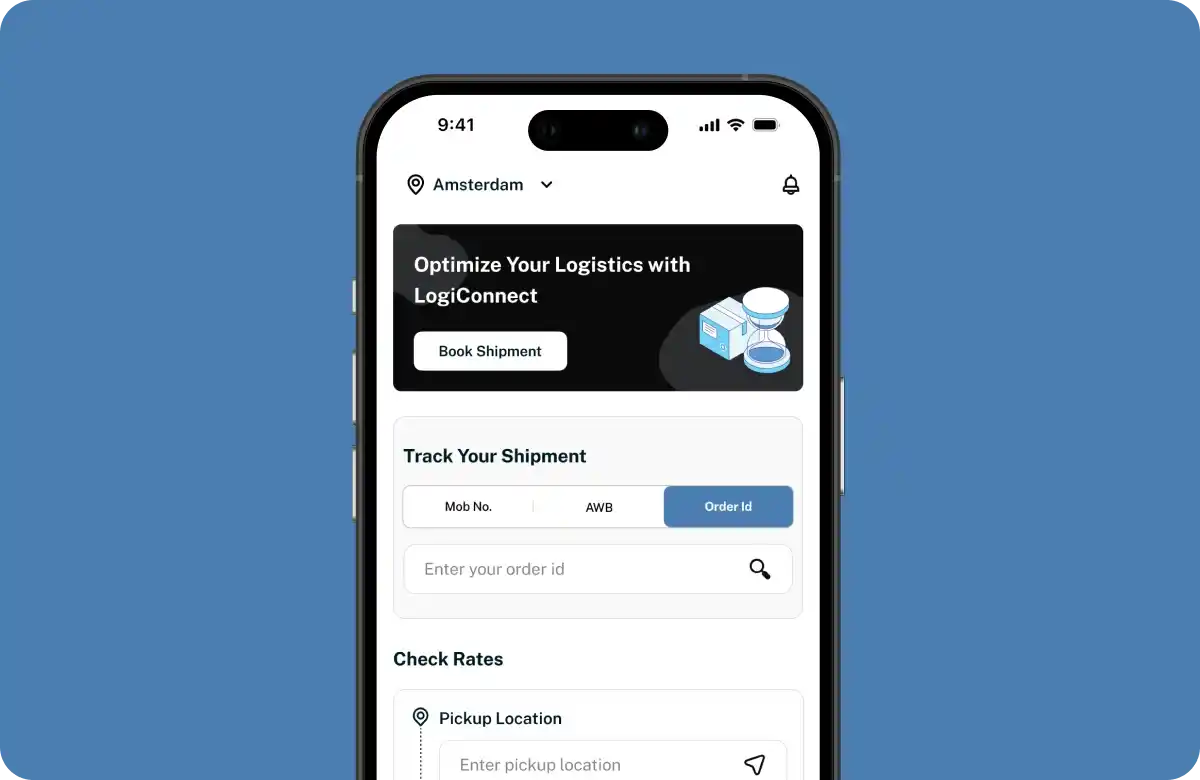
Logistics App Development Company

We build driver, dispatch, fleet and warehouse apps for iOS and Android from one Flutter codebase, so your supply chain runs on live data from the road and the warehouse floor instead of phone calls.
What Does a Logistics App Development Company Do?

What Does a Logistics App Development Company Do?

A logistics app development company designs, builds and supports the apps that move goods: driver apps, dispatch tools, fleet tracking and warehouse scanning. HireFlutterDev builds logistics apps with Flutter, so one codebase runs on iPhones, Android phones and rugged Android devices, and connects to the ERP, WMS or TMS you already use.
Starting from scratch? We plan and build the full app. Want to prove the idea first? We build a focused first version, such as a driver app with proof of delivery, and grow it from there. Already have an app that loses data or drains batteries? A Flutter app audit shows what to fix and what to rebuild.

Logistics and Supply Chain Apps We Build

Every operation moves goods differently. We shape the app around your drivers, depots and customers, not around a template.
01

Driver and Proof-of-Delivery Apps

Drivers see their stops, scan parcels and capture a photo or e-signature at the door. Every delivery leaves a timestamped record, so disputes are settled with evidence instead of guesswork.

04

Warehouse and Inventory Scanning

Receiving, picking, packing and stock counts with barcode and QR scanning on phones or rugged Android devices. Each scan updates stock in your WMS, so the numbers match the shelves.

07

Last-Mile Delivery Apps

Driver, customer and dispatcher apps for same-day and scheduled delivery, with live tracking and delivery slots. All three can share one Flutter codebase.

02

Dispatch and Route Planning

Dispatchers assign jobs, plan routes through a routing API and move work between drivers as the day changes. Drivers get the update on their phone at once, without a call.

05

Shipment Tracking for Customers

A customer app or web page with live shipment status, delivery windows and push notifications. Fewer "where is my order" calls reach your support team.

03

Fleet Management and Vehicle Tracking

Fleet management app development covers live vehicle locations, trip history, pre-trip checklists and service reminders. Data comes from the driver phone or from the APIs of the telematics devices you already have.

06

Supply Chain Visibility Dashboards

One view of orders, shipments, stock and exceptions across suppliers, warehouses and carriers. Managers spot delays early and act before customers notice.

Logistics App Features, by Who Uses Them

The building blocks most logistics apps need, matched to your fleet, your warehouse and your systems.

For Drivers: Offline-First Routes and Stops

Routes, stops and job details are stored on the phone, so drivers keep working in dead zones and basements. Changes sync when the signal returns.

For Drivers: Photo and E-Signature Proof of Delivery

Photos, e-signatures, notes and failed-delivery reasons captured at the door, each with a time and location stamp.

For Drivers: Barcode and QR Scanning

Fast scanning with the phone camera, or with the built-in scanner on rugged Android devices, to confirm every parcel at pickup and drop-off.

For Dispatchers: Live Map and Geofences

Every vehicle on a Google Maps view, with geofence alerts when a driver arrives at or leaves a depot or customer site.

For Dispatchers: Job Assignment and Routing

Drag jobs between drivers, optimize stop order through a routing API and send the new route to the driver app in seconds.

For Warehouse Staff: Scan-Based Picking and Counts

Guided pick lists, put-away and cycle counts on handheld devices, with large buttons that work with gloves on.

For Your Business: ERP, WMS and TMS Integrations

Orders, stock and shipment status flow between the app and your ERP, WMS or TMS through their APIs, so nobody types the same data twice.

For Your Business: Visibility and Smarter ETAs

Dashboards for on-time delivery and exceptions, plus AI features such as ETA predictions and reading shipping labels with the camera. See Flutter AI app development.

For Your Business: Role-Based Access

Drivers, dispatchers, warehouse staff, customers and managers each see only the data and actions their role needs.

Planning a Logistics App?

Tell us how your goods move and which systems you run today. We will suggest the first version, the integrations it needs and a clear estimate.

Get a Logistics App Estimate

Why Build Your Logistics App with Flutter

Logistics app development with Flutter gives you one codebase for every device your operation uses: drivers on iPhones, warehouse staff on rugged Android handhelds and dispatchers on a web dashboard. Flutter draws every screen itself, so the app looks and behaves the same on a budget phone and a scanner.
One codebase also means one team and one release for every role. When a delivery rule or a scan step changes, the fix reaches drivers, warehouse staff and dispatchers together, without three separate apps drifting apart.

Built for Offline Work

Offline storage on the device keeps routes, scans and proof of delivery safe without a signal, and a sync queue sends them in order when the connection returns.

Camera and Hardware Scanning

Flutter reads barcodes and QR codes with the phone camera, and connects to the built-in scanners of rugged Android devices through platform channels.

Battery-Aware Location

Location updates adapt to speed and stops, and tracking runs only during a shift, so phones last a full day on the road.

Maps and Routing Ready

Google Maps and routing APIs plug into Flutter apps for live maps, optimized stop order and one-tap directions in the maps app on the driver phone.

Phones, Rugged Devices and Web

The same code runs on iOS, consumer Android, rugged Android devices and the web, so you can mix devices as your fleet grows.

Tested Where the Work Happens

Automated tests cover scanning, sync and delivery flows, and we field-test in weak-signal areas before each release.

How We Build a Logistics App

Each step ends with something you can see and test, from the first prototype to the rollout at your depots.
01

Discovery

We walk through a working day with your drivers, dispatchers and warehouse staff, and agree on the flows the first version must support.
02

Systems and Integrations Plan

We map your ERP, WMS or TMS, telematics, map and routing APIs and the data each role needs, including what happens offline.
03

Design and Prototype

Figma prototypes with large buttons, high contrast for sunlight and as few taps as possible, tested with real drivers and pickers.
04

Flutter Development

Driver, warehouse, customer and dispatcher apps from one codebase, built in short sprints with daily work status updates.
05

Field Testing

We test sync, scanning, battery use and proof of delivery on the actual phones and rugged devices your teams use, in weak-signal areas.
06

Rollout and Support

Release through the App Store, Google Play or your device management tool, starting with one depot, then fixes and new features as you scale.

How Much Does It Cost to Build a Logistics App?

A logistics app built with Flutter usually costs $15,000 to $20,000 for a simple first version, $20,000 to $40,000 for a standard app and $40,000 to $60,000 for a complex supply chain app development project, covering iOS and Android. Want to staff your own project? Our Flutter developer rates are published by role.

Simple App: $15,000 to $20,000

A driver app with job lists, barcode scanning, photo and e-signature proof of delivery and a basic admin. Built in 6 to 10 weeks.

Complex App: $40,000 to $60,000

Driver, warehouse, customer and dispatcher apps, route optimization, geofences and deeper ERP, WMS or TMS integrations. Built in 5 to 8 months.

What Moves the Price: Integrations

Each system the app talks to, such as an ERP, WMS, TMS or telematics provider, adds build and testing time. Map and routing APIs also bill by usage.

Standard App: $20,000 to $40,000

Adds offline sync, live tracking, a dispatcher dashboard, customer notifications and one or two integrations. Built in 3 to 5 months.

After Launch: 15% to 20% a Year

Updates, fixes, new OS versions and support usually cost 15% to 20% of the build cost each year. See Flutter app maintenance and support.

What Moves the Price: Offline Sync and Devices

Offline work with conflict handling, and support for rugged devices with hardware scanners, add logic and testing that an always-online app does not need.

Driver Privacy, Data and Store Rules for Logistics Apps

Drivers, customers and your operations team all need to trust the app. These are planned from the first step.

Location Only During Shifts

The app tracks drivers only while a shift or job is active and shows them when tracking is on, so personal time stays private.

Background Location and Store Rules

Apple and Google review background location closely. We write clear permission prompts and disclosures that explain why the app needs location, so store review goes smoothly.

Secure Devices and Data

Encrypted data on the device and in transit, API keys kept on the server, and remote sign-out when a shared or rugged device goes missing.

Data Retention You Control

You set how long location history, photos and signatures are kept, and older records are deleted on schedule. We plan this with you around GDPR and CCPA for the markets you serve.

Role-Based Access

Each role sees only what it needs, and key actions such as route changes and stock adjustments are logged with who made them and when.

Your Code, Your Data

We sign an NDA before work starts, and you get the full source code and intellectual property at handoff. Your shipment and driver data stays in your systems.

Ways to Work with Us

Pick the model that fits your stage and budget, and change it as your operation grows. Need a health check on an existing app first? Book a Flutter app audit.

Fixed-Cost First Version

A fixed price for an agreed scope. Best when you know the features your drivers or warehouse need at launch.

Dedicated Flutter Developers

Developers who work only on your app, at $18 to $50 per hour with a 1-week free trial and daily work status updates. Start with one and add more as you grow.

view more

Hourly

Pay for the hours you use. Best for integrations, fixes or new features in a logistics app you already have.

Testimonials

The app was delivered ahead of schedule, leaving the client impressed with Hire FlutterDev efficiency. The vendor ensured a seamless customer experience by always addressing queries and requests promptly. Moreover, they worked flexibly to accommodate any ad hoc tasks and followed a professional approach.
Arinze Pascal
Arinze PascalCEO, Bakoomba Fitness

Start with a 1-Week Free Trial

See how our Flutter team works on your driver, warehouse or dispatch app before you commit to a longer engagement.

Talk to a Flutter Developer

Logistics Apps We Have Built

A supply chain and logistics app from our case studies. See the other industries we work with, from retail to healthcare.
Supply Chain and Logistics App Development
Increased operational efficiency by 36%

Supply Chain and Logistics App Development

Helps logistics teams track inventory and deliveries more clearly, improving daily operations.

A logistics app usually costs $15,000 to $20,000 for a simple driver app, $20,000 to $40,000 for a standard app with tracking and a dispatcher dashboard, and $40,000 to $60,000 for a complex multi-role system. With Flutter, that price covers both iOS and Android. Updates and support usually add 15% to 20% of the build cost each year.

A simple first version usually takes 6 to 10 weeks, a standard app 3 to 5 months and a complex app 5 to 8 months. Integrations with your ERP, WMS or TMS and the amount of offline work are the main factors in the timeline.

Most logistics apps need job lists, barcode and QR scanning, photo and e-signature proof of delivery, live GPS tracking and push notifications. Dispatchers need a live map, job assignment and route planning, and the business needs integrations and role-based access. We start with the features your daily operation depends on and add the rest later.

Yes. An offline-first driver app stores routes, scans, photos and signatures on the phone, so drivers keep working in dead zones. Everything syncs to your systems in order when the signal returns, and conflicts are handled by rules you agree with us.

Yes. A Flutter app can read and update orders, stock and shipment status in your ERP, WMS or TMS through their APIs. If a system has no API, we can add a small middle layer that exchanges data with it, so your existing system stays the source of truth.

We use battery-aware location updates that slow down when a vehicle is stopped and turn off when a shift ends. Drivers can see when tracking is on, and you decide how long location history is kept before it is deleted.

Yes, for most logistics apps. Flutter builds iOS, Android and web apps from one codebase, and it runs on rugged Android devices, using their built-in scanners through platform channels. Native code is only needed for rare device features, and Flutter can call it when it is.

Yes. Common AI features in logistics apps are ETA predictions, demand forecasts and reading shipping labels or delivery documents with the camera. Some of these can run on the device, which helps when drivers have no signal.

Yes. We start with an audit of your current app to find the causes of lost data, slow sync, crashes or battery drain. Then we fix the existing code or rebuild it in Flutter, whichever costs you less over time.

Yes. HireFlutterDev signs an NDA before work starts, and you get the full source code and intellectual property at handoff. Your shipment, customer and driver data stays in your own systems.