








Fintech App Development Company

We build payment, lending, budgeting and banking apps for iOS and Android from one Flutter codebase, with KYC onboarding, secure payments and the audit trail your partners will ask for.
What Does a Fintech App Development Company Do?

What Does a Fintech App Development Company Do?

A fintech app development company designs, builds and launches the apps people use to pay, borrow, save and invest, and connects them to payment, identity and banking providers. HireFlutterDev builds fintech apps with Flutter, so one codebase runs your iOS app, your Android app and, when you need it, a web dashboard for your operations team.
Founders come to us for three reasons: a new fintech app built end to end, a focused first version to prove the product with a partner bank or investors, or a rescue of an existing app that is slow, unstable or failing review.

Fintech Apps We Build

Each financial product carries its own rules and risks. We shape the app around your product and the partners behind it.
01

Digital Wallets and Payment Apps

Send, receive and request money, pay by QR code and store cards for Apple Pay and Google Pay. Payments run through your payment provider, so your app stays out of the card data path.

04

Lending and Loan Apps

Loan applications, document upload, identity checks, offers, e-signatures and repayment schedules. The decision logic stays with your lending partner or your own credit engine, and the app makes each step clear.

07

Insurance Apps

Quotes, policy purchase, digital ID cards, claims with photo upload and claim status tracking. Policyholders handle the common tasks from their phone instead of calling your team.

02

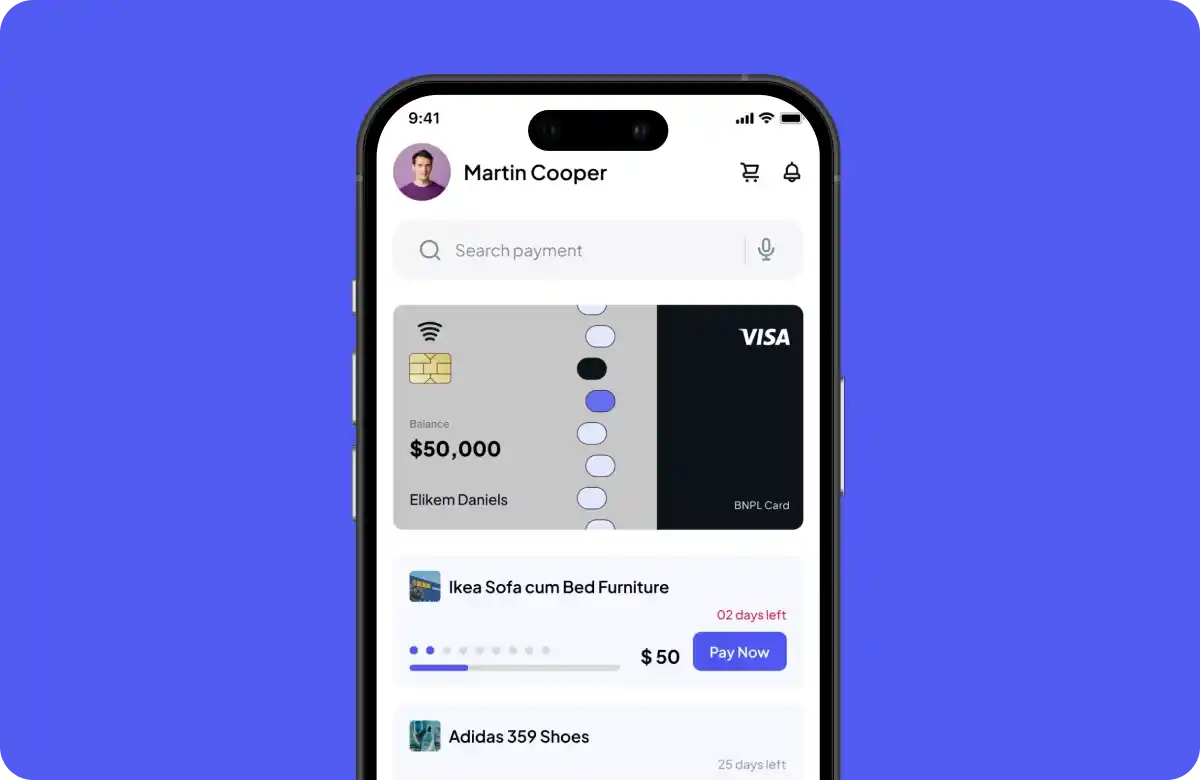
Buy Now, Pay Later Apps

Instant checkout financing, installment plans, repayment reminders and a merchant side for partner stores. We built FlexiPe, a buy now, pay later app, so these flows are familiar ground.

05

Neobank and Banking Companion Apps

Accounts, cards, transfers, statements and card controls on top of a banking-as-a-service partner or your bank core. Customers get a modern app while the regulated account sits with a licensed institution.

03

Personal Finance and Budgeting Apps

Linked accounts, spending categories, budgets, goals and bill reminders in one view. Open banking connections through an aggregator keep balances current without manual entry.

06

Investment and Trading Apps

Portfolios, watchlists, live prices, orders and statements, connected to a licensed broker or custody partner. Charts and price updates stay smooth even when markets move fast.

Fintech App Features, by Who Uses Them

The building blocks most fintech apps need, matched to your product, your partners and your team.

For Customers: Fast KYC Onboarding

Sign-up, ID document capture and a selfie check through a verification provider, with clear messages when something needs a retry, so fewer applicants drop out halfway.

For Customers: Biometric Login

Face ID, fingerprint and PIN login, with tokens kept in the iOS Keychain and Android Keystore, so the app is quick to open and hard to break into.

For Customers: Payments and Alerts

Payments, transfers and repayments in a few taps, with push notifications for every transaction, due date and unusual activity.

For Operations: Review Queue and Audit Logs

A web dashboard where your team reviews flagged sign-ups and transactions, with an audit log of who did what and when.

For Risk Teams: Fraud Signals and Limits

Device checks, velocity rules and transaction limits that your team can tune, with suspicious activity held for review before money moves.

For Support: Customer View and Disputes

Support staff see account status, recent transactions and open disputes in one place, so customers get answers without being passed around.

For the Business: Provider Integrations

Payment, KYC, open banking and banking-as-a-service providers connected through their APIs, so you can launch on proven partners instead of building the rails yourself.

For the Business: Clear Disclosures and Reports

Fees, rates, terms and repayment schedules shown before customers confirm, plus exports your finance and compliance teams can work with.

For the Business: Product Analytics

Sign-up completion, KYC drop-off, payment success and repeat use in one dashboard, so you know which flow to improve first.

Planning a Fintech App?

Tell us what your product does and which partners you work with. We will suggest the first version, the providers it needs and a clear estimate.

Get a Fintech App Estimate

Why Build Your Fintech App with Flutter

A Flutter fintech app gives customers the same fast, consistent experience on iPhone and Android from one codebase. Every payment, onboarding step and disclosure is written once, so the rules your compliance partner signed off on behave the same on both platforms.
One codebase also keeps your costs down after launch. When a partner changes an API or a regulator asks for a new disclosure, one team updates one app, and the same code can run the web dashboard your operations team uses every day.

One Set of Rules on Every Platform

Limits, validation and disclosure screens share one Dart codebase, so iOS and Android never drift apart on how money moves.

Secure Storage on the Device

Flutter plugins reach the iOS Keychain, Android Keystore and native biometric prompts, so sensitive tokens never sit in plain storage.

Native SDKs Where You Need Them

Payment, KYC and open banking providers often ship native SDKs. Flutter calls them through platform channels, so you are not limited to what has a Flutter package.

Smooth Charts and Live Balances

Flutter draws every screen itself, so price charts, balance updates and transaction lists stay responsive on low-cost phones too.

Faster First Version

Shared code and ready-made Flutter packages for Stripe, Apple Pay, Google Pay and push notifications shorten the path to your first release.

Tests on the Money Flows

Automated unit, widget and integration tests cover sign-up, payments and repayments, so a new release does not break the flows that move money.

How We Build a Fintech App

Each step ends with something you can see and test, from the first prototype to the store release.
01

Discovery

We agree on your product, your customers, the markets you launch in and the licenses or licensed partners behind it.
02

Providers and Compliance Plan

We map the payment, KYC, open banking and banking partners, the data each one holds, and the disclosures and audit logs the app must have.
03

Design and Prototype

Figma prototypes of onboarding, payments and key disclosures, tested with real users before code is written.
04

Flutter Development

iOS, Android and, if needed, a web dashboard from one codebase, built in short sprints with daily work status updates.
05

Security and Device Testing

We test onboarding, payments, limits and failure cases in provider sandboxes and on a range of real phones, and review the app for common mobile security issues.
06

Launch and Support

Release to the App Store and Google Play with the financial app details each store asks for, then fixes and new features as your product grows.

How Much Does It Cost to Build a Fintech App?

A fintech app built with Flutter usually costs $15,000 to $20,000 for a simple first version, $20,000 to $40,000 for a standard app and $40,000 to $60,000 for a complex app, covering iOS and Android. Building with an in-house team? See our Flutter developer rates for each role.

Simple App: $15,000 to $20,000

A focused first version, such as a budgeting app or a payment flow on one provider, with sign-up, biometric login and transaction history. Built in 6 to 10 weeks.

Complex App: $40,000 to $60,000

A lending, BNPL, neobank or trading app with several providers, fraud rules, a merchant or partner side and detailed audit logs. Built in 5 to 8 months.

What Moves the Price: Providers

Each payment, KYC, open banking or banking partner adds integration, sandbox testing and failure handling, so the number of providers matters more than the number of screens.

What Moves the Price: Markets

Each extra country can bring its own identity checks, disclosures, languages and payment methods, which adds design and testing time.

Standard App: $20,000 to $40,000

Adds KYC onboarding, open banking connections, notifications, an operations dashboard and more provider integrations. Built in 3 to 5 months.

After Launch: 15% to 20% a Year

Updates, fixes, new OS versions, provider API changes and support usually cost 15% to 20% of the build cost each year. See Flutter app maintenance and support.

What Moves the Price: Risk and Audit Needs

Fraud rules, transaction limits, review queues and detailed audit logs add back-end and dashboard work that a simple payment app does not need.

Security, Compliance and Store Rules for Fintech Apps

People only trust an app with their money when it feels safe. These are planned from the first step.

Card Data Stays with Your Payment Provider

Cards are handled by a PCI DSS certified payment provider through tokenization, so card numbers never touch your app or your servers.

Licenses Stay with You or Your Partner

Lending, money transmission, banking and investing are regulated. We build the app, while the licenses sit with your company or a licensed partner such as a bank or broker.

Privacy Rules Planned with You

Consent, data access and deletion requests are designed around GDPR and CCPA, which we plan with you for the markets you serve, with data encrypted on the device and in transit.

KYC and AML Through a Verification Provider

Identity checks, sanctions screening and ongoing monitoring run through a specialist provider, and the app is built to support the KYC and AML process your compliance team or partner defines.

Store Rules for Financial Apps

Apple and Google Play ask more of financial apps, such as publishing from the account of the company that offers the service and, for loan apps, extra declarations. We plan the listing and the flows to match each store policy.

Your Code, Your Data

We sign an NDA before work starts, your data stays in your own cloud and provider accounts, and you get the full source code and IP at handoff.

Ways to Work with Us

Pick the model that fits your stage and budget, and change it as your product grows. Rescuing an app that is slow or failing review? Start with a Flutter app audit.

Fixed-Cost First Version

A fixed price for an agreed scope. Best when you know the product and partners you want to launch with.

Dedicated Flutter Developers

Developers who work only on your app, at $18 to $50 per hour with a 1-week free trial and daily work status updates. Start with one and add more as you grow.

view more

Hourly

Pay for the hours you use. Best for a new provider integration, smaller changes or fixes to an app you already have.

Testimonials

The app was delivered ahead of schedule, leaving the client impressed with Hire FlutterDev efficiency. The vendor ensured a seamless customer experience by always addressing queries and requests promptly. Moreover, they worked flexibly to accommodate any ad hoc tasks and followed a professional approach.
Arinze Pascal
Arinze PascalCEO, Bakoomba Fitness

Start with a 1-Week Free Trial

See how our Flutter team works on your fintech product before you commit to a longer engagement.

Talk to a Flutter Developer

Fintech Apps We Have Built

A buy now, pay later app from our case studies. We build for other industries too, from health to travel.
FlexiPe - Buy Now Pay Later App Development
Enhanced monthly transactions by 18%

FlexiPe - Buy Now Pay Later App Development

A buy now, pay later app where shoppers spread the cost of a purchase over time.

A fintech app usually costs $15,000 to $20,000 for a simple first version, $20,000 to $40,000 for a standard app and $40,000 to $60,000 for a complex lending, BNPL, neobank or trading app. With Flutter, that price covers both iOS and Android. Updates and support usually add 15% to 20% of the build cost each year.

A simple first version usually takes 6 to 10 weeks, a standard app 3 to 5 months and a complex app 5 to 8 months. The number of payment, KYC and banking providers, and how quickly each one approves your production access, are the main factors in the timeline.

Most fintech apps need secure sign-up with KYC, biometric login, payments or transfers, transaction history, push alerts and clear disclosures of fees and terms. Behind the app, your team needs an operations dashboard, fraud rules, transaction limits and audit logs.

Yes, when it is built with the right controls. Flutter apps use the iOS Keychain, Android Keystore and native biometrics, encrypt data in transit, and leave card data to a PCI DSS certified payment provider through tokenization. Security depends on the design of the app and its back end, not on the framework alone.

We connect the app to a verification provider for KYC and AML checks and to a PCI DSS certified payment provider for card data. The app is built to support the checks your compliance team or partner defines, and card numbers never touch your servers. HireFlutterDev does not certify your business; your compliance owner signs off on the process.

It depends on what the app does: lending, money transmission, banking and investing are regulated in most markets. Many startups launch through a licensed partner such as a bank, a banking-as-a-service provider or a broker. We build the app and its integrations, and the licenses stay with you or your partner.

Yes. A buy now, pay later app includes instant checkout financing, installment plans, repayment reminders, identity checks and a merchant side for partner stores. HireFlutterDev built FlexiPe, a buy now, pay later app, which you can see in our case studies.

Flutter is a strong fit for most fintech apps because one codebase keeps payment rules, onboarding and disclosures identical on iOS and Android. When a provider only ships a native SDK, Flutter calls it through platform channels. Fully native apps make sense mainly when a product depends on a platform feature with no Flutter route.

Yes. Common AI features include spending categories, budget suggestions, support assistants and signals that help your team spot unusual activity. We keep sensitive financial data inside your own systems and providers, and lending or fraud decisions stay with rules and people your team controls.

Yes. We start with an audit of the code, security, provider integrations and store review status, then agree on a plan to fix or rebuild it. You keep the full source code and IP throughout, and we sign an NDA before we look at anything.