Key Takeaways
Every founder who emails us about this asks some version of the same question before they've even written a job post: Flutter or Swift? It sounds like a technical question. It's really a hiring question wearing a technical costume, because whichever framework you pick determines who you need to hire, what that person costs, and how fast you can ship.
Quick verdict: Choose Swift if you're building an iOS-only app, need tight integration with Apple hardware (ARKit, WidgetKit, Apple Watch), or already have an iOS team in place. Choose Flutter if you need iOS and Android from one team, want to launch on a fixed budget, or aren't sure yet whether Android matters. Starting cross-platform is cheaper than migrating to it later.
The rest of this guide backs that verdict with 2026 numbers: performance data, build costs, and (since this is where most comparisons stop short) what a Flutter developer actually costs to hire versus a Swift developer in the current US market.
| Factor | Flutter | Swift |
| Owner | Apple | |
| Language | Dart | Swift |
| Platforms | iOS, Android, web, Windows, macOS, Linux | iOS, macOS, watchOS, tvOS, visionOS |
| Rendering | Impeller engine (mandatory on iOS) | Native UIKit/SwiftUI, direct Metal access |
| Best for | Multi-platform apps, fast iteration | iOS-only apps, deep Apple integration |
| US developer cost (avg/yr) | ~$119,700 | ~$132,000–$137,000 |
| Learning curve | Gentle for web/JS/Kotlin developers | Steeper outside the Apple ecosystem |
Flutter is Google's open-source UI toolkit for building apps from a single Dart codebase that run on iOS, Android, web, and desktop. It doesn't call native UI components. It draws every pixel itself through its own rendering engine, which is why a Flutter app looks and behaves identically on a Pixel and an iPhone. That consistency is a feature if you want unified branding across platforms. It's a mild drawback if "feels exactly like a first-party Apple app" is the entire point of your product.
Swift is Apple's language for native software across the Apple ecosystem: iOS, macOS, watchOS, tvOS, and now visionOS. It compiles straight to machine code with no framework layer sitting between your app and the hardware. Swift 6, which shipped in 2024, finished a multi-year push to catch concurrency bugs at compile time instead of letting them surface as crashes in production. That mattered a lot to teams who got burned by race conditions in the Objective-C and early-Swift years, and the language has kept iterating through the 6.x line since.
Closer than the framework debates of 2019 would suggest, and the reason is one specific piece of engineering: Impeller. Flutter's older Skia renderer compiled shaders at runtime, which caused the visible stutter developers call "shader jank" the first time an animation played. Impeller precompiles shaders ahead of time instead. Per Flutter's own documentation, Impeller is now the only supported rendering engine on iOS (there's no toggle back to Skia), and it's the default on Android API 29 and above, falling back to the older OpenGL renderer only on unsupported devices.
What that buys you in practice: for standard business-app UI (lists, forms, navigation, moderate animation), Flutter and Swift are close enough that most users won't tell the difference. Swift still wins on raw cold-start time, since there's no framework layer to spin up, and on anything that leans on Metal directly, like custom particle systems, heavy real-time video, or AR-heavy interactions. A CRUD app with a clean interface won't notice this gap. A camera app doing live frame processing will.
This is where the math tips toward Flutter, and it tips harder the more platforms you need. Building iOS-only, Swift and Flutter aren't far apart. Xcode and SwiftUI Previews are mature, fast tools. The moment Android enters the picture, Swift needs a second codebase, usually in Kotlin, usually with a second developer or team. Flutter needs one.
Hot reload changes the daily rhythm of building UI, too: save a file, watch the running app update in under a second with state intact. SwiftUI Previews have closed part of that gap but still fail to build more often and don't preserve state as reliably. On screens you're iterating on a dozen times a day, that difference adds up fast. Not in theory. In actual sprint velocity.
Set salaries aside for a second. The build itself costs differently depending on your platform target:
None of that accounts for who's actually writing the code, though. That's the number most comparisons skip.
Here's the part most "Flutter vs Swift" articles leave out entirely, and it's the number that actually sets your budget.
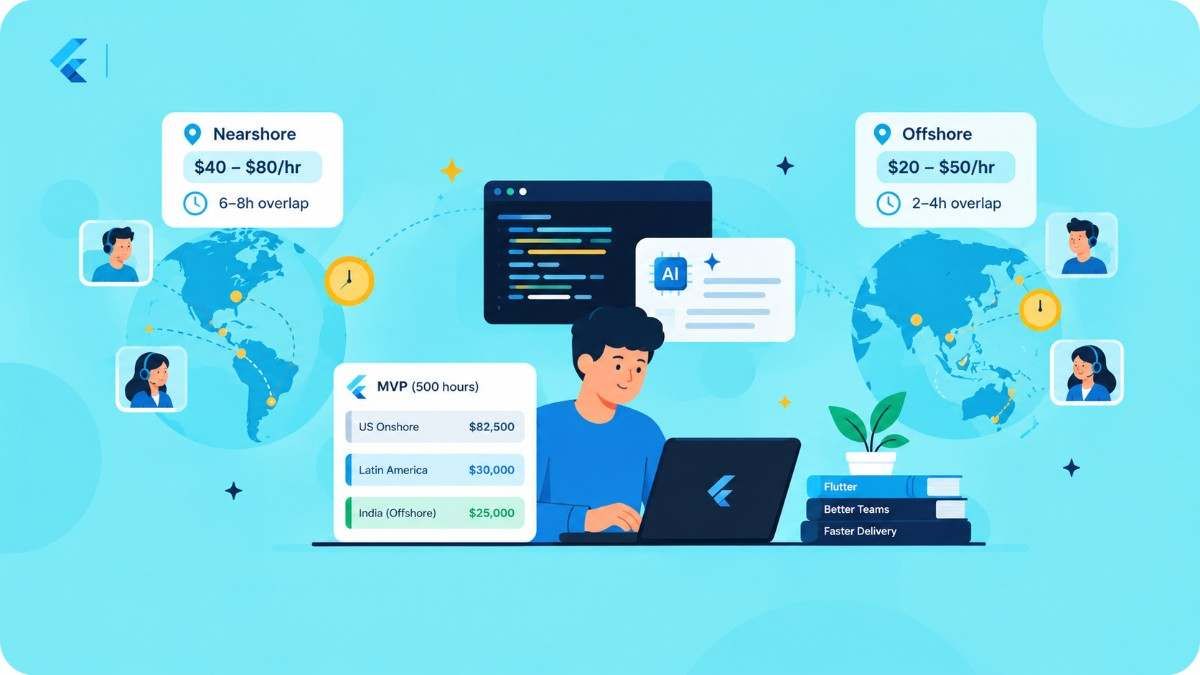
As of mid-2026, Glassdoor's US salary data puts the average Flutter developer at $119,740 per year (about $58/hour), with a typical range of $94,000 to $154,000 depending on seniority. iOS developer pay runs meaningfully higher. Glassdoor's iOS Developer figures average $131,675, and Indeed's broader 2026 dataset puts the US average closer to $137,000, with senior roles regularly clearing $170,000.
| Role | US Avg Salary (2026) | Typical Range |
| Flutter Developer | $119,740/yr (~$58/hr) | $94,000 – $154,000 |
| iOS / Swift Developer | $131,675 – $137,000/yr | $104,000 – $168,000+ |
Line those numbers up against the platform math above, and the gap gets bigger, not smaller. An iOS + Android product built in Swift needs an iOS developer and an Android/Kotlin developer: two salaries, two hiring searches, two people who have to stay in sync on the same feature set. The same product built in Flutter needs one developer who ships both platforms from a single codebase. You're not just saving 10 to 15 percent on an individual salary. You're avoiding the second hire entirely.
This is the calculation we walk through with most founders who come to us undecided. If Android is anywhere on your roadmap in the next year or two, the Flutter hire is very often the cheaper and faster path, not despite the lower average salary but because of exactly what that salary replaces.
SwiftUI tracks Apple's Human Interface Guidelines automatically. Dynamic Type, Dark Mode, VoiceOver, and system gestures behave exactly as an iOS user expects, because they're the same components Apple's own apps use. If "indistinguishable from a first-party Apple app" is a real requirement, SwiftUI gets you there with the least effort.
Flutter's Cupertino widgets mimic iOS conventions closely, and most users genuinely won't spot the difference day to day. Where Flutter pulls ahead is custom design: apps like Google Pay use Flutter specifically because they want one distinctive visual identity across platforms, rather than "iOS looks like iOS, Android looks like Android." If your brand's visual language matters more than platform convention, that's a point for Flutter, not against it.
Flutter's package registry, pub.dev, carries more than 40,000 packages, and the flutter/flutter GitHub repository sits above 170,000 stars, a rough proxy for how much active development and community troubleshooting surrounds it. Swift's first-party coverage runs deeper in one specific way: watchOS apps, WidgetKit home-screen widgets, App Clips, and visionOS all require native Swift. There's no cross-platform shortcut, and Flutter's plugin bridges can't fully substitute for same-day access to brand-new Apple APIs.
Recent Stack Overflow Developer Survey data puts Dart/Flutter usage and Swift usage in roughly the same band, each in the high single digits of overall developer usage. Neither is a fringe bet in 2026. Both are mainstream enough that hiring isn't a search-and-rescue mission, just a different cost bracket.
Both platforms ship apps that pass Apple's review process without friction, and there's no structural bias against Flutter in App Store guidelines. Apple reviews behavior and policy compliance, not implementation framework. Swift gets direct, first-party access to Keychain, Face ID, and App Sandbox with no abstraction layer. Flutter reaches the same iOS security APIs through plugins, which work well but add one more dependency to keep current. That's worth a line item in your maintenance plan, not a reason to avoid Flutter for anything security-sensitive.
Pick Swift if you're iOS-only with no Android on any realistic horizon, your app depends on Apple Watch, WidgetKit, App Clips, or visionOS, your team already knows Swift and has shipped iOS apps before, or the last few percent of native performance genuinely matters (real-time video, heavy AR, high-frequency interactive UIs). In these cases, the abstraction layer Flutter adds isn't buying you anything. It's just overhead.
Pick Flutter if you need iOS and Android live at the same time, you're a small team that can't staff two native squads, your runway rewards speed over platform-perfect polish, or you genuinely don't know yet whether Android matters. That last point is worth sitting with: porting a Swift-only app to cross-platform later costs more than starting cross-platform and simply not shipping to Android if it turns out you don't need to.
| Your Situation | Best Choice | Why |
| Startup MVP, iOS + Android launch | Flutter | One codebase, one hire, faster launch |
| iOS-only enterprise tool | Swift | Team likely exists; no cross-platform tax |
| Consumer app needing Apple Watch/WidgetKit | Swift | No Flutter equivalent exists |
| Budget-constrained, platform undecided | Flutter | Cheapest path to keep both options open |
| Camera/AR/real-time video app | Swift | Direct Metal access matters here |
| Distinct brand UI across platforms | Flutter | Widget system gives full design control |
Neither wins outright. It depends on your platform target. Swift gives the best raw performance and Apple integration for iOS-only apps; Flutter gives you iOS and Android from one codebase, which is the better economic choice unless you're certain Android is off the table.
For most apps, yes. Flutter's Impeller engine renders standard UI at native-comparable frame rates. Swift keeps an edge in startup time and in graphics-heavy work like AR or real-time video that uses Metal directly.
Yes, on average: US Flutter developers earn around $119,740 per year versus $131,675 to $137,000 for iOS/Swift developers, per 2026 Glassdoor and Indeed data. The bigger savings usually come from needing one developer instead of separate iOS and Android hires.
No. Flutter compiles to native ARM code and follows standard App Store requirements. Google Pay has shipped on Flutter for iOS for years. Apple's review checks app behavior and guideline compliance, not which framework built it.
For most startups targeting both platforms, one Flutter developer is faster to hire and cheaper than staffing two native specialists. The exception is when the product needs platform-specific features, like Apple Watch or advanced AR, that only a native team can build.
Yes, but it's a rewrite of the UI and business logic in Dart, not a direct port. Backend APIs and databases usually carry over unchanged. Budget roughly 60 to 70 percent of a from-scratch build, and plan a phased migration rather than one cutover.

Paresh Mayani
14 September 2026

08 September 2026

Paresh Mayani
01 September 2026
Let’s begin a collaborative journey together where we craft Flutter applications that set benchmarks for you.