You have an iOS and Android app on the roadmap, a launch date, and nobody on staff who writes Dart. The median US software developer earned $135,980 in May 2025, before benefits. Teams outsource Flutter app development because they need a working team in weeks, and a single hire rarely delivers that.
Outsourcing fits when the scope is clear, someone in-house owns product decisions, and the app is not your core technology. It is the wrong move when the app is the product and you plan a large engineering team within a year.
We sell Flutter development and Flutter developers, so we have an interest in this question. We have tried to be plain about when outsourcing is the wrong call, and most of the fixes below need no vendor at all.

Key takeaways
- Benefits make up about 30% of US private-sector employer compensation costs, so a salary understates the cost of a hire.
- Offshore Flutter rates sit far below US freelance rates, but you pay for that gap in specs, overlap hours and review time.
- Own the repository, store accounts and IP from day one, whoever writes the code.
- Start with a short pilot and written acceptance criteria before any long contract.
- Keep the work in-house if the app is your core product and you plan to grow a large team soon.
Why is it so hard to build the app in-house?
Cost is the first problem, and it is bigger than the salary alone. The US Bureau of Labor Statistics puts the median software developer wage at $135,980 a year as of May 2025. Benefits add more on top, because they made up 30.0% of private-industry compensation costs in BLS employer cost data for June 2026.
Coverage is the second problem, because a Flutter app needs many skills. It needs Dart code, native iOS and Android builds, store submission, a backend and testing. One developer rarely covers all of that well, and you still need design.
Risk is the third problem, and it grows with a team of one. A single in-house developer is a single point of failure. If that person leaves mid-build, the knowledge leaves with them.
None of this means outsourcing is automatically better. It means the in-house option has hidden costs you should count before you compare quotes.
When does outsourcing make sense, and when does it not?
| Your situation | Outsource? | Why |
|---|---|---|
| First version of a new app, clear scope, small or no tech team | Usually yes | You get a full team quickly and can bring work in-house later |
| Existing team that lacks Flutter skills for a fixed period | Yes, as staff augmentation | Dedicated developers fill the gap without new permanent hires |
| The app is your core product and IP | Only for a short start | You will need the knowledge inside the company long term |
| Scope still changes every week | Not yet | Any vendor will burn budget until the product direction settles |
| Regulated data with strict residency rules | With care | Check where developers work and what data they can reach |
For a deeper look at the two outsourcing models, read our comparison of hiring Flutter developers versus a project agency.
Fixes you can apply before you pay anyone
These steps reduce cost and risk with any partner, including none. Do them first, and every quote you receive becomes easier to compare.
1. Cut the first version to its core
List every feature, then mark the few a first user cannot live without. Flutter builds iOS and Android from one Dart codebase, so a tight scope saves money twice. Every cut feature is one less thing to design, build, test and maintain.
2. Own the accounts and the code from day one
Create the Git repository, Apple Developer account, Google Play console and cloud projects under your company. Give the vendor access, never ownership. Put the assignment of code and designs to you in writing before work starts.
3. Write acceptance criteria and ask for tests
Write down what done means for each feature, in plain sentences a tester can check. Ask for automated tests at the three levels the Flutter testing docs describe. Those are unit tests for logic, widget tests for single screens and integration tests for whole flows.
4. Agree overlap hours and a weekly demo
Two to four shared working hours a day are enough for most projects. A weekly demo of the running app catches misunderstandings before they turn into rework. Written updates fill the gaps between calls.
5. Start with a short pilot
Give a shortlisted team one real feature for one or two weeks before a long contract. You learn how they write code, ask questions and handle feedback. Ask a senior developer you trust to review that code before you commit.
What does outsourcing cost compared with hiring?

| Option | Typical cost | Source and date |
|---|---|---|
| US software developer, employed | $135,980 median salary, plus benefits worth about 30% of total compensation | BLS, May 2025 and June 2026 |
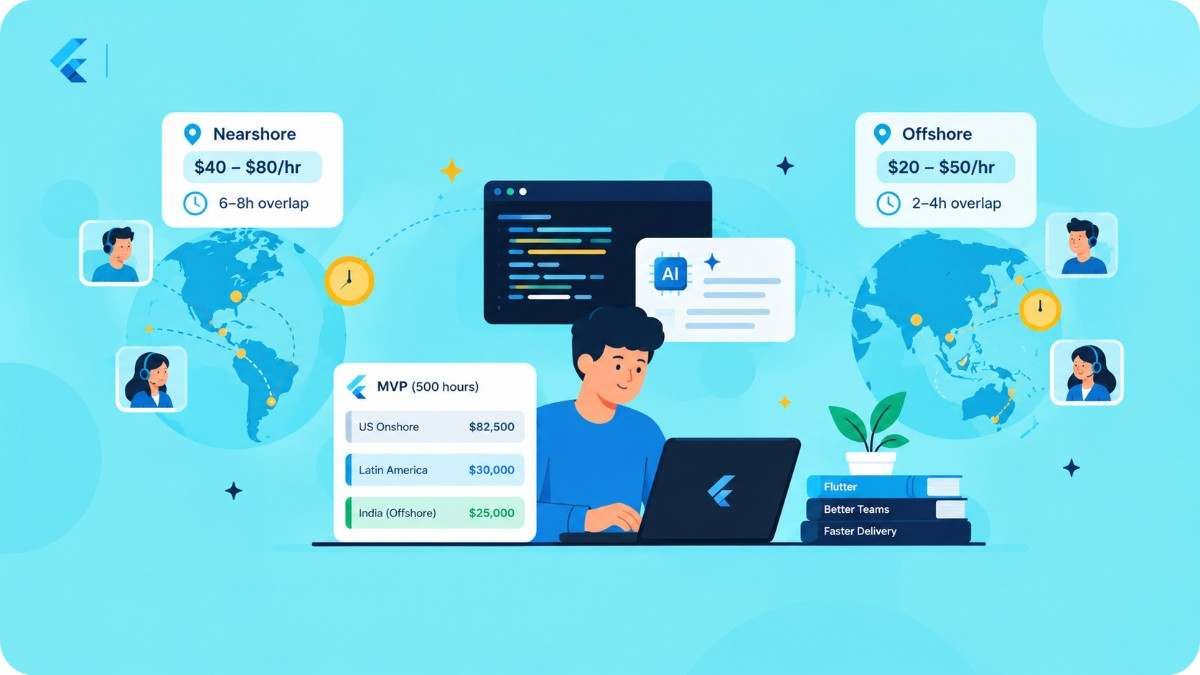
| US and Canada freelance developer | $82–$130 per hour | Arc, May 2026 |
| Latin America (nearshore for US) | $35–$75 per hour | Arc, May 2026 |
| South Asia, including India | $22–$55 per hour | Arc, May 2026 |
| App developers listed on Clutch | Typically $25–$49 per hour | Clutch, updated September 2026 |
| Hire Flutter Dev developers | $18–$50 per hour | Our pricing page, November 2026 |
The regional ranges come from Arc's survey of freelance developer rates, which Arc calls directional benchmarks. Clutch puts the average mobile app project cost at $90,780 across its reviewed projects.
A lower hourly rate is not the same as a lower total cost. Weak specs, slow feedback and rework can erase the gap, which is why the fixes above come first. For a full breakdown by region and seniority, see our guide to the cost to hire a dedicated Flutter developer.
How should you structure an outsourcing deal?
Most vendors offer three engagement models. Pick the one that matches how settled your scope is.
- Fixed price. Best when the scope is written and stable. You trade flexibility for a known budget, and every change becomes a change request.
- Dedicated developers. Best for ongoing product work with a moving roadmap. You direct the developers, and you carry the risk of unclear priorities.
- Hourly. Best for small fixes, reviews or audits. It gets expensive if you use it for a full build without a cap.

Whatever the model, the contract should cover a few basics. It should name the developers, set milestones with acceptance criteria and assign IP to you. It should also define handover documentation and the notice period if either side ends the deal.
What are the real risks, and how do you reduce them?

- Misunderstood requirements. Reduce it with written acceptance criteria and a weekly demo of the running app.
- Time zone gaps. Agree overlap hours in the contract, and keep decisions in a shared written log.
- IP and data exposure. Own every account, sign an NDA and limit production data to people who need it.
- Quality drift. Require tests, code review on every merge and a release checklist.
- Lock-in. Ask for architecture notes and a handover plan, so another team could take over.
- Forgotten maintenance. Budget for updates after launch. Our pricing page estimates 15% to 20% of the build cost a year.
Where an outsourced Flutter team does the job better
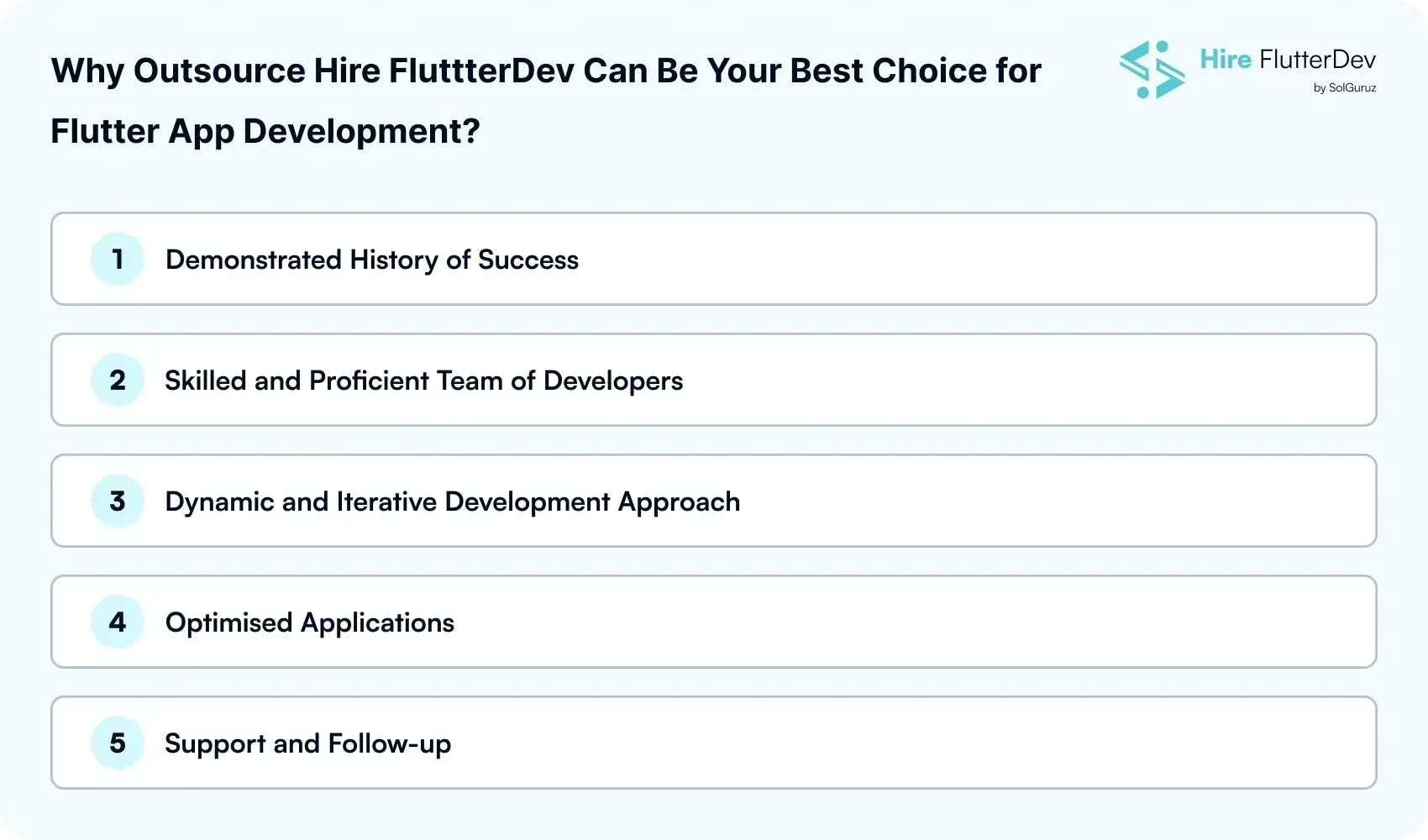
An outside team earns its fee when you need several skills at once for a fixed period. Design, Flutter code, QA and store release can start together instead of one hire at a time.
Our own Flutter app development service works that way. The published pricing lists $18–$50 per hour for developers, and simple app builds at $15,000–$20,000 over 6 to 10 weeks. Every engagement starts with a 1-week free trial, so you can judge real output first.
You can see the kind of work involved on our published case studies page, which lists 16 projects across healthcare, fintech, travel and more. Judge those against the other vendors you shortlist, using the same pilot and the same checks.

Who outsourcing is not right for

- Companies whose app is the core product. If the app is your main asset, build the team inside the company, even if you start with outside help.
- Teams with no one to own product decisions. A vendor cannot decide what your users need, and guessing is expensive.
- Projects with a scope that changes daily. Settle the direction with prototypes first, then bring in a build team.
- Apps that need native-only platform features on day one. Check that Flutter suits the app before you hire any Flutter team.

Frequently asked questions
Is it cheaper to outsource Flutter development than to hire in-house?
Per hour, usually yes, since offshore rates sit well below a US salary plus benefits. The total cost depends on how clear your scope is and how much rework follows. A short pilot shows you the real cost before you commit.
How do I protect my code and IP when I outsource?
Keep the repository, store accounts and cloud projects in your company's name from day one. Put the assignment of code and designs to you in the contract, and sign an NDA. Ask a lawyer to check the IP clauses before you sign.
What engagement model should I choose for a first Flutter app?
Choose fixed price if your scope is written and stable. Choose dedicated developers if the roadmap will keep moving after launch. Many teams start fixed price for the first version and switch to dedicated developers afterwards.
How many overlap hours do I need with an offshore team?
Two to four shared hours a day work for most projects. Use them for questions, reviews and decisions, and keep status updates in writing. A weekly demo of the running app matters more than daily meetings.
Can I bring the app in-house later?
Yes, if you planned for it from the start. Own every account, ask for architecture notes and require tests, so a new team can take over. Overlap the old and new teams for a few weeks during the handover.
The calm way to decide
Count the full cost of a hire, then compare it with outsourced quotes on the same written scope. Own your accounts and IP, insist on tests and run a short pilot first. If Flutter fits your app and you want a team to try, talk to our Flutter team about a free trial week.